How Many Watts Does a Camper Fridge Use: 40 to 80W Explained
A typical camper fridge uses between 40 and 80 watts while running, but the real number that matters for battery planning is daily amp-hours. Most 12V compressor fridges consume 30 to 60 amp-hours per day in moderate weather, though actual power consumption varies significantly with ambient temperature and insulation quality.
This guide covers running versus startup draw, sizing your battery bank correctly, and reducing consumption without sacrificing food safety.
Understanding Compressor Fridge Power
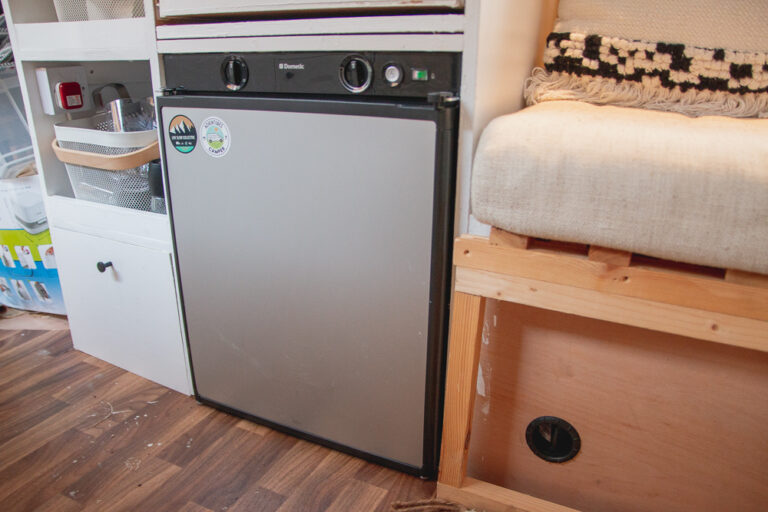
A 12-volt compressor fridge is an insulated cooling box designed specifically for mobile living, using a variable-speed compressor to maintain safe food temperatures off-grid. It’s built for RVs, vans, and campers where shore power isn’t guaranteed, and it runs directly from house batteries or solar systems rather than standard AC outlets. The common misconception is that wattage alone determines battery drain, but duty cycle matters far more than peak draw.
These fridges don’t run continuously like household models; they cycle on and off based on internal thermostat settings and external heat load. A unit rated at 60 watts might only draw that power 30% of the time in mild weather, averaging just 18 watts hourly.
However, in hot conditions above 90°F, the same unit can run 70% of the time, tripling actual consumption. Always check the manufacturer’s spec sheet for both average amp-hour consumption and maximum current draw, as these figures tell different stories about real-world performance.
Running Your Camper Fridge Efficiently
Setting up your camper fridge correctly prevents wasted energy and protects your battery bank from unexpected depletion. These steps assume a standard 12V compressor fridge installed in a ventilated cabinet; if you’re using a three-way absorption fridge or residential AC model, consult the manufacturer’s installation manual instead.
- Install ventilation grilles at the bottom and top rear of the fridge compartment, maintaining at least 2 inches of clearance behind the condenser coils for proper airflow.
- Connect the fridge directly to your house battery bank using appropriately sized wire (typically 10 AWG for runs under 15 feet) to prevent voltage drop that increases amp draw.
- Set the thermostat to 37°F for refrigeration, which balances food safety per USDA guidelines with energy efficiency; every degree colder increases consumption by roughly 5%.
- Pre-cool the fridge contents before loading by plugging into shore power or running the engine for two hours prior to departure.
- Monitor actual consumption for 48 hours using a shunt-based battery monitor to establish your baseline amp-hour usage in current weather conditions.
- Adjust thermostat settings seasonally, raising to 38-39°F in cooler weather below 70°F ambient to reduce unnecessary cycling.
The critical judgement call here is distinguishing between normal high-temp operation and malfunction. If your fridge runs continuously above 80% duty cycle despite adequate ventilation and correct thermostat settings, the door seal may be compromised or refrigerant levels low—both require professional service rather than user adjustment.
Camper Fridge Watts Consumption Chart
Actual consumption depends heavily on ambient temperature, ventilation quality, and how often you open the door. Use this table as a starting point, then verify with your own battery monitor readings after 48 hours of normal use.
| Situation | What to use | How long / Daily draw | What to watch for |
|---|---|---|---|
| Mild weather (60-75°F) | Standard 12V compressor | 30-40 Ah/day | Normal cycling, 20-30% duty cycle |
| Hot weather (85-95°F) | Same unit, good ventilation | 50-65 Ah/day | Extended run times, check vent clearance |
| Extreme heat (95°F+) | Same unit, max ventilation | 65-80 Ah/day | Near-continuous operation, consider shade |
| Poor ventilation installed | Any compressor fridge | +20-30% over baseline | Condenser overheating, frequent shutdowns |
| Frequent door openings | Family camping, 10+ opens/day | +15-25% over baseline | Temperature recovery time, meal planning |
| Winter camping (below 40°F) | Compressor with heater mode | 15-25 Ah/day | Thermostat accuracy, prevent freezing |
| Absorption fridge on propane | Three-way RV fridge | Minimal electric draw | Propane consumption, level parking required |
Getting Better Efficiency From Your Fridge
Experienced van lifers and RV owners focus on thermal mass and airflow management rather than chasing lower wattage ratings. They pre-chill beverages and freeze water bottles to act as cold sinks, reducing compressor workload during peak heat hours. This trade-off sacrifices some interior space for significantly lower amp-hour consumption, especially valuable when boondocking beyond three days.
They also install reflective insulation barriers between the fridge compartment and exterior walls, particularly in metal-bodied vans where radiant heat transfer is severe. Checking door seals monthly with the dollar bill test catches degradation before it costs extra amp-hours nightly. If the bill slides out easily when the door closes, replace the gasket immediately—a worn seal can increase daily consumption by 15-20% without obvious symptoms.
What they avoid is stuffing the fridge completely full or blocking internal air vents with tall containers. Overpacking restricts circulation, forcing longer run times to reach setpoint temperature. Leaving 20% empty space maintains proper airflow and actually reduces total energy use despite having less thermal mass. This mistake costs beginners dearly when their carefully calculated battery budget fails mid-trip because the fridge worked harder than expected.
Troubleshooting High Power Draw
When your camper fridge consumes more power than specifications suggest, systematic diagnosis prevents unnecessary part replacement. Start with the simplest explanations before assuming compressor failure or refrigerant loss.
| What you notice | What it usually means | What to do first |
|---|---|---|
| Runs constantly, never cycles off | Door seal leak or blocked vents | Test seal with paper, clear rear airflow path |
| High amp draw but cycles normally | Voltage drop in wiring | Measure voltage at fridge terminals under load |
| Short cycling (on/off every few minutes) | Thermostat sensor displaced | Reposition sensor away from evaporator plate |
| Normal operation but high daily Ah | Ambient heat soak through walls | Add insulation barrier, park in shade |
| Compressor hums but doesn’t cool | Low refrigerant or failed start relay | Professional diagnosis required, DIY unsafe |
| Works fine on shore power, weak on battery | Undersized wiring or weak battery | Check wire gauge, test battery health under load |
If troubleshooting reveals electrical issues beyond basic connections and ventilation, stop there. Diagnosing sealed-system problems or testing capacitors requires specialized equipment and training; attempting repairs risks injury or voiding warranties. Contact an RV appliance technician for sealed-system work.
Electrical Safety Standards
This prevents fire hazards from short circuits in undersized or damaged wiring. Your fridge’s fuse rating must match the manufacturer’s specification exactly; oversizing defeats protection entirely.
Never install a camper fridge in an unventilated enclosure or route DC wiring through propane compartments. If your installation lacks proper overcurrent protection or ventilation, hire a certified RV electrician to bring it to code before use. , making professional inspection worthwhile for older rigs or DIY conversions.
Maintaining Performance Long-Term
Clean the condenser coils as needed based on usage and according to the owner’s manual using compressed air or a soft brush to maintain heat exchange efficiency. Dust buildup forces longer run times and higher amp draw, gradually degrading compressor lifespan. Check door gaskets regularly and clean them with mild soap to prevent sticking and seal degradation from food residue.
Record your baseline amp-hour consumption in different seasons so you’ll recognize abnormal increases early. Most compressor fridges have a finite service life with proper maintenance, but neglecting coil cleaning can significantly reduce that expectancy.
When storage exceeds two weeks, leave the door slightly ajar to prevent mold growth, and disconnect power to eliminate phantom draws that slowly damage deep-cycle batteries through chronic undercharging.
10 Best Food for Camping Without Fridge Picks (Easy & Delicious Ideas)
When Other Cooling Methods Work Better
A 12V compressor fridge isn’t always the right choice despite its popularity. For weekend warriors who always have shore power access, a residential AC fridge offers superior capacity and efficiency at lower cost, eliminating battery anxiety entirely. The trade-off is dependency on grid power or a large inverter system.
Three-way absorption fridges excel for extended boondocking when propane is available and level parking is guaranteed. They use minimal electricity but require perfect leveling to prevent permanent damage to the cooling unit.
If you frequently camp on uneven terrain or need reliable cooling while driving on winding roads, stick with compressor technology despite higher electrical demands.
For ultralight backpacking setups or vehicles with tiny battery banks under 100Ah, passive coolers with ice remain viable. Modern rotomolded coolers hold ice five to seven days, costing zero amp-hours. The trade-off is active ice management and limited temperature control, but for trips under a week without solar recharge capability, simplicity beats complexity.
Frequently asked questions
Can I run a camper fridge on solar panels alone?
Yes, with adequate panel capacity and battery storage. You’ll typically need 300-400 watts of solar panels and at least 200Ah of lithium battery capacity to reliably power a compressor fridge through cloudy periods. Actual requirements depend on your geographic location, seasonal sun hours, and other electrical loads competing for the same charging current.
Why does my fridge use more power than the specs say?
Manufacturer ratings assume ideal laboratory conditions at 77°F ambient temperature with perfect ventilation. Real-world factors like high humidity, poor installation airflow, frequent door openings, and hotter ambient temperatures all increase actual consumption. Measure your own usage with a battery monitor rather than relying solely on published specifications for trip planning.
How long will my battery run a camper fridge?
Runtime equals your usable battery capacity divided by daily fridge consumption. A 200Ah lithium battery with 80% depth of discharge provides 160 usable amp-hours, running a 40Ah/day fridge for approximately four days. Lead-acid batteries offer only 50% usable capacity, halving that duration for the same rated size.
Is it safe to run a camper fridge while driving?
Yes, modern 12V compressor fridges are designed for mobile operation and include vibration-resistant mounting points. Ensure your alternator can handle the additional load alongside other vehicle electronics, and verify that wiring connections won’t vibrate loose. Three-way absorption fridges shouldn’t operate on propane while driving due to carbon monoxide and fire risks.
What happens if my camper fridge loses power overnight?
Food stays safely cold for approximately four hours if the door remains closed, per USDA food safety guidelines. After that, perishables enter the danger zone above 40°F. Install a battery monitor with low-voltage alarms to receive warnings before complete depletion, and keep a digital thermometer inside to verify temperatures after any power interruption.
Can I plug a 12V camper fridge into household AC?
Not directly without a properly sized AC-to-DC converter rated for continuous refrigerator loads. Standard phone chargers or laptop adapters lack sufficient amperage and will overheat. Purchase a dedicated 12V power supply matching your fridge’s maximum current draw plus 20% headroom, ensuring it provides stable voltage regulation under varying load conditions.
Conclusion
Your actual consumption will differ from every chart and specification based on your specific installation, climate, and usage patterns. The only number that truly matters for trip planning comes from your own battery monitor after several days of representative use in conditions matching your intended travel style.