Portable Power Station Vs Portable Generator (Stop Buying the Wrong Backup Power)
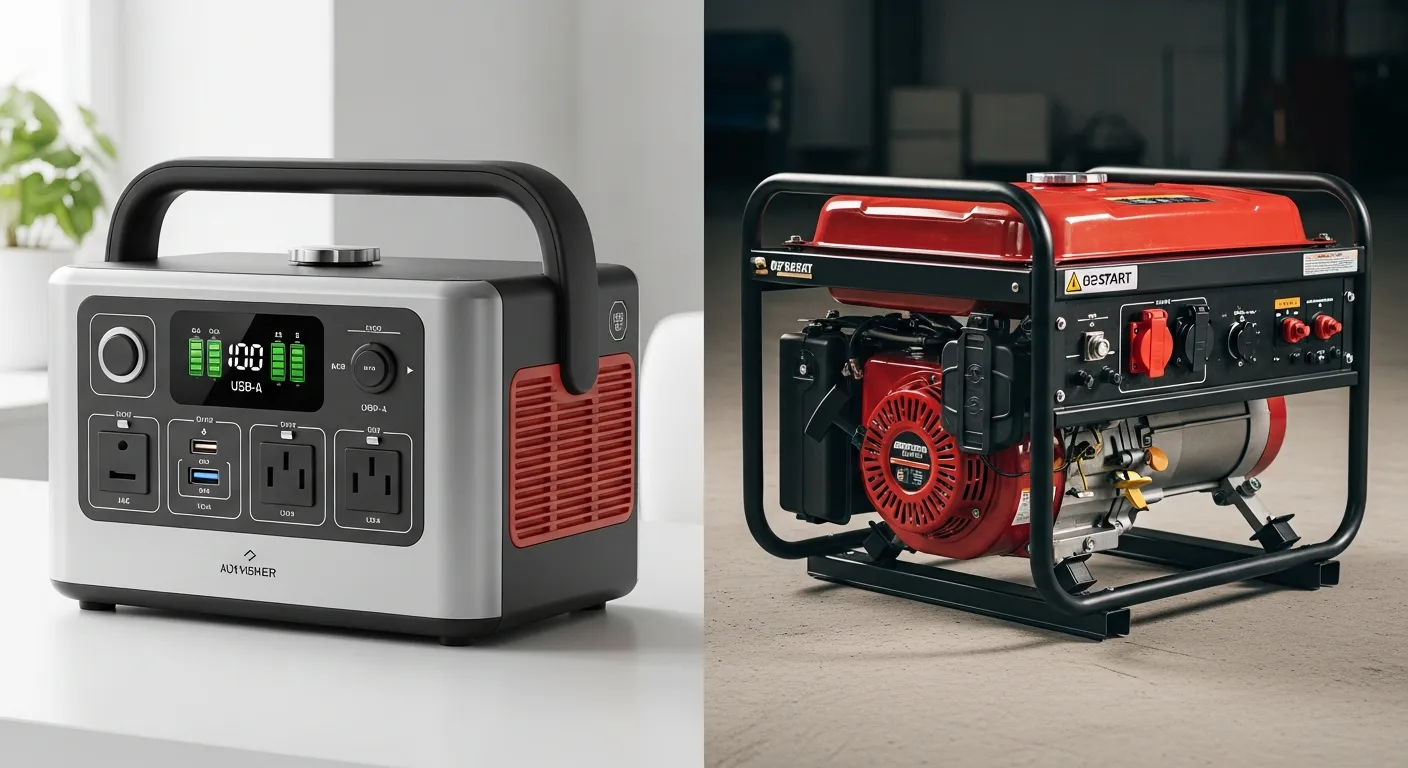
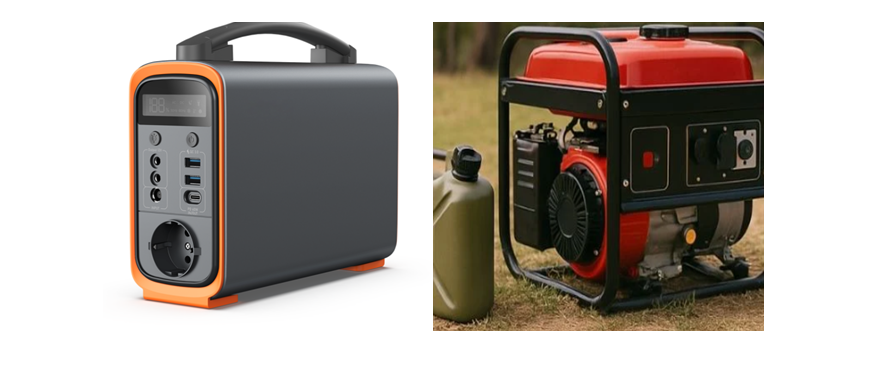
For most people in the United States, a portable power station is better for quiet indoor backup, phones, laptops, small medical devices, and short outages. A portable generator is better when you need high power for long periods, fuel is available, or you want to run large appliances such as a refrigerator, sump pump, or window air conditioner.
The key difference is simple:
- A portable power station stores electricity in a battery.
- A portable generator makes electricity by burning fuel.
Your best choice depends on power needs, outage length, noise, fuel storage, weather, safety, and budget. This guide explains the trade-offs without treating either option as the right answer for every U.S. home.
Portable Power Station vs. Portable Generator at a Glance
A portable power station is usually cleaner, quieter, and easier to use. A portable generator usually provides more energy for a longer time and can be refueled in minutes.
| Feature | Portable power station | Portable generator |
|---|---|---|
| Energy source | Stored battery power | Gasoline, propane, or dual fuel |
| Indoor use | Usually suitable when used as directed | Never use indoors or in an attached garage |
| Noise | Very quiet or silent | Loud, though inverter models are quieter |
| Emissions | No exhaust while running | Produces carbon monoxide and other exhaust |
| Runtime | Limited by battery capacity | Limited mainly by fuel supply |
| Refueling | Recharge from an outlet, car, or solar panels | Add fuel while following shutoff and cooling rules |
| Large loads | Limited by inverter size | Better for high starting and running loads |
| Maintenance | Low, but batteries age | Regular maintenance is required |
| Fuel storage | Not needed | Requires safe fuel storage |
| Weather limits | Keep dry and within the manual’s temperature range | Keep dry and well ventilated outdoors |
| Best use | Quiet, short-term, low-to-medium power | Long outages and high-power loads |
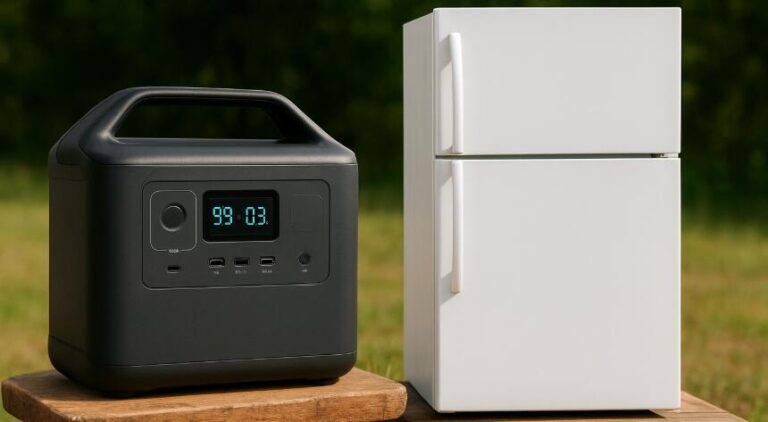
A power station may be called a battery generator, but it is not a fuel generator. The term “generator” can create confusion because a battery unit stores power rather than making it from fuel.
What Is a Portable Power Station?
A portable power station is a rechargeable battery system with built-in outlets. It may include:
- AC outlets for household plugs
- USB-A and USB-C ports
- A 12-volt car-style outlet
- An internal inverter
- A battery management system
- A display that shows power use and remaining charge
- Charging inputs for wall power, a vehicle, or solar panels
Most current models use lithium-ion or lithium iron phosphate batteries. Lithium iron phosphate is often written as LiFePO4. Battery chemistry affects weight, cycle life, charging behavior, and safety.
The power station’s watt-hour rating shows how much energy it stores. A 1,000-watt-hour unit does not normally deliver 1,000 watt-hours to your devices. Some energy is lost in the inverter and other electronics.
A simple estimate is:
Usable energy = battery capacity × estimated efficiency
For example, a 1,000 Wh power station operating at an estimated 85% overall efficiency may provide about 850 Wh of usable AC energy.
Actual results vary by load, temperature, battery age, inverter efficiency, and the manufacturer’s low-battery settings. Treat the calculation as a planning estimate, not a guarantee.
What does inverter power mean?
The inverter changes battery power into household-style AC power. Its rating determines what the power station can run.
A unit may list:
- Continuous watts: The power it can provide over time
- Peak or surge watts: A short burst available for startup
- USB output: Power available through USB ports
- 12-volt output: Power available through DC ports
A refrigerator, pump, or motor may need much more power when it starts than when it runs. A power station with enough watt-hours may still fail if its inverter cannot handle the startup surge.
What Is a Portable Generator?
A portable generator uses an engine to turn fuel energy into electricity. Common U.S. options include:
- Gasoline generators
- Propane generators
- Dual-fuel gasoline and propane generators
- Conventional generators
- Inverter generators
A conventional generator often runs the engine at a fixed speed. An inverter generator can vary engine speed and then produce clean, stable AC power through electronic controls. Inverter models are often quieter and may be better suited to sensitive electronics, but they can cost more and may produce less maximum power for their size.
A generator’s output is usually listed in watts. Some manufacturers list both:
- Rated or running watts: Power available during normal operation
- Starting or surge watts: Short-term power for motor startup
A fuel generator can continue operating as long as it has fuel, proper airflow, and enough maintenance. That makes it useful during multi-day outages, but it also creates more safety and upkeep requirements.
The U.S. Consumer Product Safety Commission warns that portable generators can cause fatal carbon monoxide poisoning. The agency says to operate them outside and at least 20 feet from the house, with exhaust directed away from doors, windows, and vents. Always follow the generator manual and local rules. See the CPSC generator safety guidance.

Which Is Better for Home Backup?
A portable generator is usually better for whole-room or high-load backup. A portable power station is usually better for a small set of essential devices.
A power station may run:
- Phones and tablets
- Wi-Fi equipment
- LED lights
- Laptops
- Small fans
- Televisions
- CPAP machines
- Small medical equipment, if the manufacturer approves the power source
- A refrigerator for limited periods, depending on its startup demand and battery size
9 Best Portable Power Station For 12V Fridge:(Tested for Battery Life & Value)
A generator may run:
- Refrigerators and freezers
- Sump pumps
- Gas furnace blowers
- Window air conditioners
- Well pumps, if properly sized
- Power tools
- Several household devices at once
Neither option automatically powers your home through the wall. Plugging a generator into a wall outlet can send electricity back into utility lines. This practice, called backfeeding, can injure or kill utility workers and damage equipment.
To connect a portable generator to selected household circuits, the installation normally requires a properly rated transfer switch or interlock system. A qualified electrician should assess the panel, grounding arrangement, generator inlet, circuit loads, and local code requirements.
A practical load example
Imagine you want backup power for:
- Wi-Fi router: 15 W
- Two LED lamps: 20 W total
- Laptop: 60 W
- Refrigerator: 150 W while running, with a higher startup demand
The normal running load is about 245 W. A power station may handle that running load, but the refrigerator’s startup surge could still exceed the inverter rating.
If the devices run for six hours, the basic energy use is:
245 W × 6 hours = 1,470 Wh
With inverter losses and the refrigerator’s cycling pattern, you would likely need more than 1,470 Wh of rated battery capacity. A fuel generator rated above the required starting load may run these devices longer, provided it is operated safely outdoors.
Which Costs Less: a Power Station or Generator?
The purchase price is only part of the cost. Compare the equipment, fuel, maintenance, charging, accessories, and replacement needs.
Portable power station costs
A power station has no gasoline cost while operating. You may still pay for:
- The initial battery unit
- Solar panels or charging cables
- A protective case
- Battery replacement after years of use
- Electricity used to recharge it
Its operating cost is often predictable. If you recharge from the electric grid, the energy cost is usually modest compared with buying fuel, though this depends on local electricity rates and battery size.
Portable generator costs
A generator may cost less than a large battery system with the same high-power output. Ongoing expenses may include:
- Gasoline or propane
- Engine oil
- Spark plugs
- Air filters
- Fuel stabilizer
- Maintenance or repair
- Safe fuel containers
- A cover or storage area
Gasoline can degrade during storage. The U.S. Department of Energy recommends following fuel and equipment guidance carefully, including the generator manufacturer’s instructions and safe storage practices. Never store fuel in a living area, basement, or near an ignition source.
The cheaper purchase is not always the cheaper emergency system. A power station may cost more at first but need little routine care. A generator may cost less to buy but more to run during a long outage.
How Long Will Each One Run?
A power station’s runtime depends mainly on battery capacity and device load. A generator’s runtime depends on fuel tank size, engine efficiency, fuel type, and load.
Power station runtime formula
Use this estimate:
Runtime in hours = battery watt-hours × efficiency ÷ device watts
For example, a 500 Wh power station running a 50 W device at an estimated 85% efficiency:
500 Wh × 0.85 ÷ 50 W = about 8.5 hours
The real runtime may be shorter because power stations use some energy even when the load is small. Devices with chargers, motors, compressors, or standby modes can also change the result.
Generator runtime
Generator manuals often provide estimated runtime at a stated load, such as 25%, 50%, or full load. Do not compare runtime figures unless the test conditions match.
A generator that runs for 10 hours at 25% load may run for much less time at 75% load. Running only the devices you need can reduce fuel use, noise, and engine wear.
Do not refuel a hot generator. Turn it off, let it cool, and follow the manufacturer’s instructions. Gasoline spilled on a hot engine can ignite.
Which Is Safer?
A portable power station removes the main exhaust risk because it does not burn fuel while operating. It can still present electrical, fire, and battery risks.
Use a power station safely by:
- Keeping it dry unless it is specifically rated for wet conditions
- Using the correct charger
- Avoiding damaged cables and plugs
- Leaving airflow around the unit
- Keeping it away from heat and flammable materials
- Following the storage charge range in the manual
- Not using a swollen, cracked, leaking, or unusually hot battery
- Disconnecting it if it smells abnormal or shows signs of damage
A portable generator creates carbon monoxide, a colorless and odorless gas. The Centers for Disease Control and Prevention says carbon monoxide poisoning can happen when fuel-burning appliances operate in enclosed or partly enclosed spaces. See the CDC carbon monoxide prevention guidance.
Follow these generator rules:
- Operate the generator outdoors only.
- Keep it at least 20 feet from the home unless the manual or local authority requires more distance.
- Point the exhaust away from buildings, doors, windows, and vents.
- Never operate it in a garage, carport, basement, crawl space, shed, or porch.
- Install carbon monoxide alarms on each level of the home and outside sleeping areas.
- Keep the generator dry and use only approved weather protection that does not restrict airflow.
- Turn it off before refueling.
- Keep children and pets away.
A carbon monoxide alarm is an important backup measure. It does not make indoor generator use safe.
Which Is Better for Noise and Neighbors?
A portable power station is the clear winner for low noise. Its inverter and cooling fan may make some sound, but it has no engine or exhaust.
That makes it useful for:
- Apartments
- Condos
- Campgrounds with noise rules
- Nighttime use
- Medical equipment
- Work calls
- Homes with sleeping children
- Neighborhoods with strict local rules
A generator produces engine, fan, and exhaust noise. Inverter generators often reduce noise at low loads, but “quiet” does not mean silent. Check the manufacturer’s sound rating and its test condition. A decibel number at a specific distance is not directly comparable with a number measured at another distance or load.
Noise can also signal a sizing problem. A large generator running a tiny load may be less efficient and more intrusive than a smaller unit sized for the actual need.
Can You Use Solar Panels With Either Option?
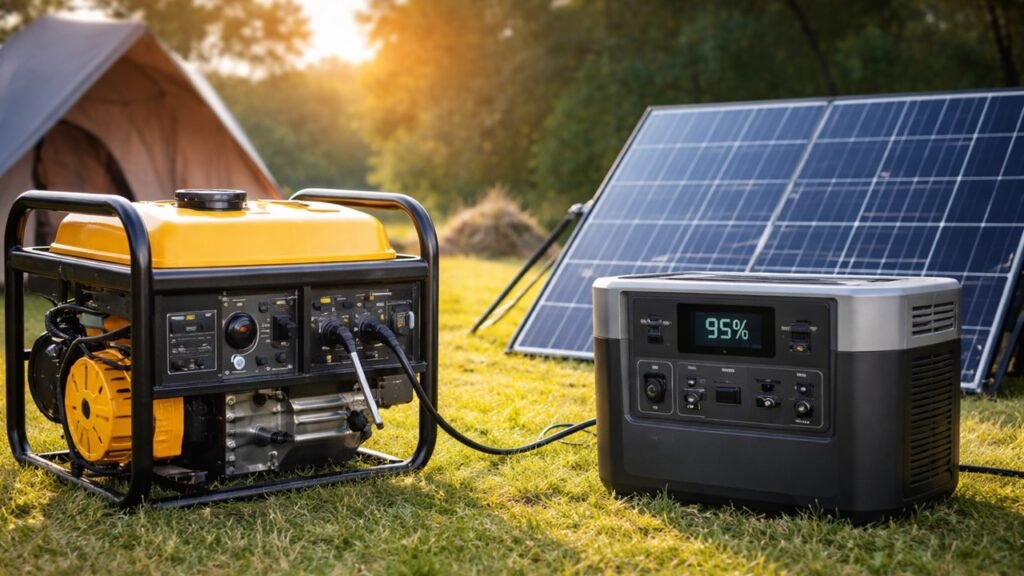
Solar panels can recharge a compatible power station during an outage. This can extend operation when sunlight is available, but solar charging is not constant.
Charging depends on:
- Panel wattage
- Sun angle
- Shade
- Clouds
- Temperature
- Cable and connector limits
- The power station’s maximum solar input
- Battery charge level
A solar panel rated at 200 W will not necessarily deliver 200 W all day. The rating is based on controlled test conditions. Check the power station manual for voltage, current, connector type, and maximum solar input.
Some generators can accept solar input only through a separate battery system or charger. A standard gasoline generator does not become a solar generator simply because you own a solar panel.
Solar panels may also be less useful during storms, smoke, heavy cloud cover, or winter conditions. Plan for a wall outlet, vehicle charging, or fuel when sunlight is not reliable.
Which Handles Refrigerators, Pumps, and Air Conditioners Better?
Generators usually handle large motor loads better, especially when the generator has enough starting watts. Refrigerators, pumps, compressors, and air conditioners can draw a short surge when their motors start.
A power station can run these devices only if all of the following are true:
- The inverter supports the starting surge.
- The continuous output is high enough.
- The battery has enough usable energy.
- The outlet and cable can carry the load.
- The device does not exceed the power station’s limits.
The appliance label may show running amps, but startup demand may not appear. A refrigerator may also cycle on and off, so its average energy use can be lower than its maximum running load.
For critical equipment, use the manufacturer’s power data or measure the load with a suitable watt meter. If the device powers a medical system, follow the medical device maker’s backup-power guidance. Ask a qualified electrician or equipment provider when failure could create a health or safety risk.
Starting watts matter most for motors
A unit rated at 1,000 running watts may have a higher short-term surge rating. That does not guarantee it can start every pump or compressor.
For a generator, compare:
- Running watts
- Starting watts
- Fuel type
- Voltage
- Receptacle type
- Transfer-switch compatibility
For a power station, compare:
- Continuous AC output
- Surge output and surge duration
- Battery capacity
- Low-voltage cutoff behavior
- UPS or backup mode, if needed
- Output waveform and device compatibility
Many modern power stations advertise a feature that temporarily supports loads above the normal output. Such features may reduce voltage or alter the output rather than provide full rated power. Use the manual to determine whether the feature is suitable for motors, heaters, or sensitive equipment.
What About a CPAP Machine or Medical Equipment?
A power station may be convenient for a CPAP machine because it is quiet and produces no indoor exhaust. However, runtime depends on the machine, humidifier, heated hose, pressure settings, and battery capacity.
A heated humidifier can use much more energy than the CPAP blower alone. For a longer runtime, some users reduce heat settings, but that should be discussed with a health professional or follow the device maker’s instructions.
Before an outage:
- Ask the equipment maker which backup sources are approved.
- Check whether the device requires a particular waveform or voltage.
- Measure or confirm the device’s watt-hour needs.
- Test the complete setup before an emergency.
- Keep a second charging plan if the outage may last several days.
Do not assume a device is safe just because it fits the outlet. Medical equipment may have specific electrical requirements, and a power failure can have serious consequences.
Are Portable Power Stations Safe to Use Indoors?
Many portable power stations are designed for indoor use because they do not produce combustion exhaust. That does not mean every model is safe in every indoor location.
Read the manual for:
- Indoor-use approval
- Ventilation needs
- Charging limits
- Temperature range
- Water resistance
- Clearance around vents
- Battery damage warnings
- Smoke or fire response
Do not use a damaged battery. If a lithium battery swells, becomes very hot, smokes, leaks, or gives off a strong odor, move people away if it is safe to do so and contact local emergency services. Do not handle a damaged battery casually or put it in household trash.
A power station should not be placed where children can access outlets, where liquid can spill on it, or where heat can build up.
Which Is Easier to Maintain?
A power station is easier to maintain because it has no engine, oil, carburetor, or fuel system. Maintenance still matters.
For a power station:
- Keep the battery at the storage level recommended by the manual.
- Recharge it on a schedule.
- Test it under a modest load before storm season.
- Inspect cords and ports.
- Update firmware only through the manufacturer’s approved process.
- Store it within the stated temperature range.
For a generator:
- Run it at the interval in the manual.
- Change oil as required.
- Inspect the air filter and spark plug.
- Use fresh fuel and approved storage methods.
- Use fuel stabilizer when the manufacturer permits it.
- Keep records of service.
- Start and test it before hurricane, tornado, wildfire, or winter storm season.
- Replace damaged cords and worn parts.
A generator that has never been tested may fail when the power goes out. A battery that has been stored empty may also fail to provide its rated capacity.
How Do You Choose the Right Size?
Start with the devices you truly need, not every appliance in the house.
Step 1: Make a load list
Write down each device and its:
- Running watts
- Starting watts, if it has a motor
- Hours of use per day
- Priority during an outage
Step 2: Separate running load from startup load
Add the running watts of devices that may operate at the same time. Then account for the largest startup surge.
Do not simply add every listed starting watt number together. Many devices start at different times. However, avoid relying on perfect timing if the equipment is critical.
Step 3: Estimate energy use
Use:
Daily watt-hours = watts × hours of use
Example:
| Device | Power | Use | Daily energy |
|---|---|---|---|
| Wi-Fi router | 15 W | 24 hours | 360 Wh |
| LED lights | 20 W | 5 hours | 100 Wh |
| Laptop | 60 W | 6 hours | 360 Wh |
| Television | 100 W | 4 hours | 400 Wh |
| Total | — | — | 1,220 Wh |
This hypothetical plan uses about 1,220 Wh before inverter loss. A power station would need more than that listed capacity for one day. A generator would need enough fuel to provide the same energy while also handling the devices’ starting loads.
Step 4: Choose a backup goal
Your goal may be:
- Keeping phones and lights running
- Preserving food in a refrigerator
- Powering a medical device
- Running a sump pump
- Maintaining heat
- Supporting a home office
- Powering several circuits
A small, clear goal often costs less and works better than trying to back up the whole home with a portable unit.

Can You Run a Portable Generator in Rain?
Generators must stay dry, but they also need open airflow and exhaust clearance. Do not place one under a porch, inside a shed, or under an improvised cover that traps exhaust.
Use only a manufacturer-approved generator tent or cover designed for that model and operating condition. Keep the unit on a stable, dry surface away from standing water.
Never touch electrical connections with wet hands. Do not connect wet cords or use damaged outdoor cables. Use outdoor-rated extension cords with the correct current rating, and keep connections elevated and protected from water.
The same basic rule applies to power stations: keep them dry unless the manufacturer clearly rates them for the conditions. Water resistance is not the same as safe operation in heavy rain or flooding.
Common Mistakes to Avoid
Buying by watt-hours alone
A high Wh rating does not help if the inverter cannot start your refrigerator or pump. Check both battery capacity and output capability.
Ignoring startup watts
Motor-driven equipment often needs a short surge. Confirm the generator or power station can handle it.
Using a generator indoors
This can cause carbon monoxide poisoning or fire. A garage door being open does not make indoor operation safe.
Backfeeding a home
Never connect a generator to a wall outlet. Use a properly installed transfer switch or interlock when connecting to household circuits.
Storing gasoline carelessly
Use approved containers and follow local fire rules. Keep fuel away from living areas, heat, flames, and electrical equipment.
Assuming solar charging is constant
Clouds, shade, angle, and short winter days can greatly reduce solar input.
Waiting for an outage to test the system
Test the full setup before you need it. Include the actual cords, loads, chargers, and transfer equipment.
Overloading extension cords
Use cords rated for the load and outdoor conditions. Heat, damaged insulation, loose plugs, and repeated breaker trips are warning signs.
Treating manufacturer claims as universal results
Runtime, noise, cycle life, and surge performance depend on test conditions. Read the exact model manual and compare like with like.
Key Takeaways
- Choose a portable power station for quiet, low-maintenance backup of electronics, lights, communications, and selected small devices.
- Choose a portable generator for longer outages, high power demands, motors, pumps, air conditioners, and easier refueling.
- A power station has no combustion exhaust, but it still needs safe battery and electrical use.
- A generator must operate outdoors, away from doors, windows, vents, and living spaces.
- Compare both watts and watt-hours. Watts determine what a unit can run; watt-hours help determine how long it can run.
- For home circuits, use a qualified electrician and the correct transfer equipment.
- Test the complete backup plan before an emergency.
Frequently Asked Questions
Is a portable power station better than a generator?
It is better for quiet, simple, short-term backup and indoor use when the model allows it. A generator is better for high loads and long outages because fuel can be replaced quickly.
Can a portable power station run a refrigerator?
It can if the inverter supports the refrigerator’s startup surge and the battery has enough usable capacity. Check both continuous and peak output before buying.
Can a generator charge a portable power station?
Often, yes. The generator must provide compatible AC power, and the charging method must follow both manuals. Some generators may produce unstable power under changing loads, so check the power station maker’s guidance.
Do portable power stations work during a power outage?
Yes, if they are charged before the outage or connected to a usable charging source. A basic power station must be manually connected to devices. Some models include an uninterruptible power supply feature, but its transfer time and compatibility vary.
Which lasts longer: a generator or a power station?
A generator can operate for many days with fuel and maintenance. A power station is limited by its battery and recharge options. Battery capacity also declines over time, while a generator can continue working for years with proper service.
Can I connect either one to my home electrical panel?
Not directly. A generator or power station must be compatible with a properly installed transfer switch or interlock system. Have a qualified electrician evaluate the installation.
Conclusion: Choose by Load, Runtime, and Safety
The portable power station vs. portable generator decision becomes easier when you list the devices you need, their starting demands, and the likely outage length.
Choose a power station when quiet operation, simple charging, low maintenance, and no combustion exhaust matter most. Choose a portable generator when you need higher output, longer runtime, or fast refueling for refrigerators, pumps, tools, and climate equipment.
Before buying, check the exact model’s manual, output ratings, charging limits, safety instructions, and local requirements. Then test the setup before the next outage—not during it.