The Ultimate Portable Power Station Size Guide (Complete Guide)
For most homes in the United States, a portable power station from 500 to 1,000 watt-hours (Wh) is a useful starting point for phones, lights, Wi-Fi, laptops, and small medical or camping devices. Choose 1,000 to 2,000 Wh for a refrigerator, CPAP machine, or longer outages. Choose 2,000 Wh or more when you need to run several devices, high-load tools, or essential home circuits for many hours.
The right size depends on two numbers:
- Watt-hours (Wh): how long the battery can supply energy.
- Watts (W): how much power the station can provide at one time.
A large battery may still fail if its inverter cannot handle a device’s starting surge. This portable power station size guide explains how to match both numbers to your needs in the United States.
Introduction
A portable power station is a rechargeable battery with an inverter, outlets, USB ports, and charging inputs. In the U.S., most household devices use 120-volt AC power at 60 hertz, so check that the station’s AC output matches your equipment.
The easiest way to size a power station is to:
- List the devices you want to run.
- Add their running watts.
- Check for startup or surge watts.
- Estimate how many hours each device will operate.
- Convert the total to watt-hours.
- Add a reserve for charging losses and uncertainty.
This method works for camping, road trips, home backup, emergency preparedness, job sites, and RV use.
What Do Watts and Watt-Hours Mean?
Watts measure power at a given moment. Watt-hours measure stored energy over time. You need both measurements when choosing a portable power station.
Watts: the size of the load
Watts tell you how much power a device needs while it runs. For example:
- A 10-watt LED lamp needs about 10 watts.
- A 60-watt laptop charger may draw up to 60 watts.
- A 100-watt mini fridge may use about 100 watts while its compressor runs.
Add the running watts of devices that will operate at the same time. The power station’s continuous AC output should be higher than that total.
Watt-hours: the size of the battery
Watt-hours show how much energy the battery stores. A 1,000-Wh power station does not normally deliver 1,000 Wh to AC devices. Some energy is lost in the inverter, wiring, battery management system, and heat.
For a basic planning estimate:
Usable AC energy ≈ rated watt-hours × 0.80 to 0.90
The actual result varies by model, load size, temperature, battery age, output type, and manufacturer limits. Treat this range as a planning estimate, not a guarantee.
Amp-hours are not enough by themselves
Some batteries use amp-hours (Ah) instead of watt-hours. Convert them with this formula:
Watt-hours = amp-hours × volts
For example, a 20-Ah battery rated at 12 volts has:
20 Ah × 12 V = 240 Wh
This calculation gives the battery’s nominal energy. The energy available at an AC outlet will be lower after conversion losses.
How to Calculate the Right Portable Power Station Size
Use the following five-step process before you shop.
Step 1: Make a device list
Write down every device you may need during an outage or trip. Group them by priority:
- Essential: CPAP machine, refrigerator, phone, medical equipment
- Useful: Wi-Fi router, laptop, lights, fan
- Optional: TV, game console, coffee maker, electric blanket
This prevents you from buying a large battery for devices you will not use.
9 Best Portable Power Station For 12V Fridge:(Tested for Battery Life & Value)
Step 2: Find each device’s actual wattage
Look for a label on the device or power adapter. You can also check the owner’s manual or use a plug-in watt meter.
Do not rely only on a generic online chart. Actual power use can differ by model and operating mode.
For devices labeled in amps, use:
Watts = volts × amps
A device rated at 120 volts and 2 amps uses:
120 V × 2 A = 240 W
Some labels show input ranges. Use the highest listed value when checking whether the inverter can handle the load.
Step 3: Estimate the daily or outage runtime
Multiply each device’s watts by the number of hours you plan to use it.
Energy needed = watts × hours
Example:
- 50-watt laptop
- Used for 6 hours
50 W × 6 hours = 300 Wh
For a device that cycles on and off, use its average energy use if you know it. A refrigerator may have a high compressor load but may not run continuously.
Step 4: Add the energy needs together
Here is a hypothetical one-day emergency setup:
| Device | Estimated running power | Planned use | Estimated energy |
|---|---|---|---|
| LED lights | 20 W | 5 hours | 100 Wh |
| Wi-Fi router | 12 W | 12 hours | 144 Wh |
| Laptop | 50 W | 4 hours | 200 Wh |
| Phone charging | 10 W | 2 hours | 20 Wh |
| Small fan | 40 W | 6 hours | 240 Wh |
| Total | — | — | 704 Wh |
The total is 704 Wh. If you divide that by 0.85 for estimated conversion losses, you get about 828 Wh of battery capacity.
A power station rated near 1,000 Wh would provide a more practical fit than a 700-Wh model because it leaves some reserve.
Step 5: Check the inverter output and surge rating
The battery capacity may be large enough, but the inverter must also support the load.
If your devices use 350 watts at the same time, choose a station with a continuous AC rating above 350 watts. A margin of about 20% or more can help with changes in load, but the device’s manual remains the final source.
For motor-driven devices, check startup power. Refrigerators, pumps, compressors, and some power tools may briefly need much more power than their running rating.
Portable Power Station Size Chart
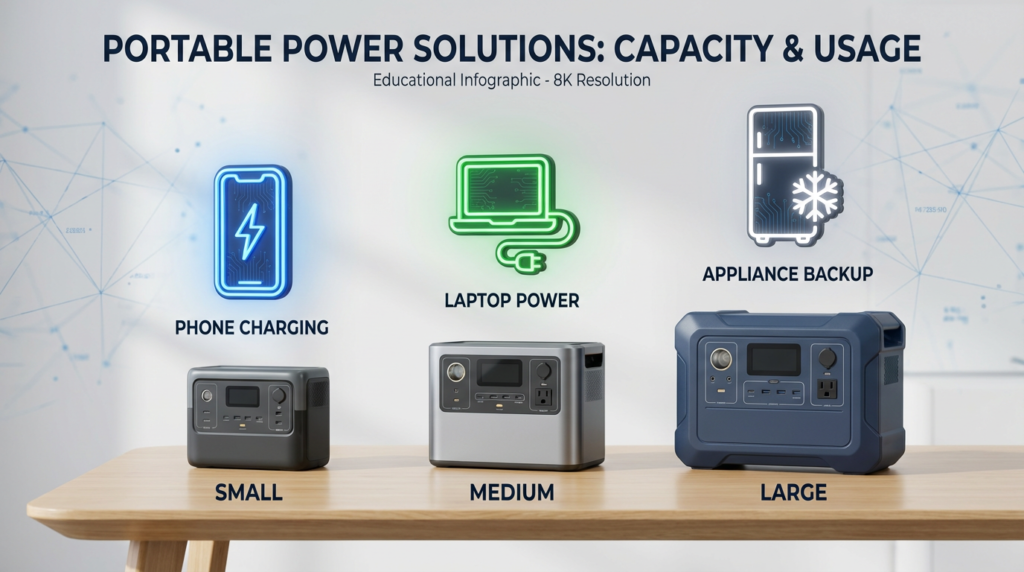
The table below gives general planning ranges for common U.S. uses. These are estimates, not guarantees. Device wattage and runtime vary by model.
| Power station size | Common uses | Typical limits |
|---|---|---|
| Under 300 Wh | Phones, tablets, lights, cameras, small laptops | Limited runtime; usually not suitable for refrigerators |
| 300–600 Wh | Laptops, CPAP use for one night, lights, routers, small fans | May run a small fridge for a limited period if surge output is adequate |
| 600–1,000 Wh | Basic outage kit, electronics, CPAP, small fridge, camping loads | May need careful scheduling during long outages |
| 1,000–2,000 Wh | Refrigerator backup, multiple electronics, medical equipment, longer camping trips | Heavier and slower to recharge than small units |
| 2,000–3,000 Wh | Several essential devices, larger refrigerators, tools, extended outages | Often needs wheels or handles; high loads reduce runtime quickly |
| Over 3,000 Wh | Large emergency loads, RV use, job sites, multiple appliances | May be difficult to move and may require expansion batteries or special charging plans |
The main trade-off is simple: more capacity gives longer runtime, but it usually adds cost, weight, charge time, and storage needs.
How Big a Power Station Do You Need for a Refrigerator?
A refrigerator usually needs more inverter capacity than its average energy use suggests. The compressor may draw a short startup surge several times higher than its normal running power.
For refrigerator backup:
- Check the refrigerator’s nameplate or manual.
- Look for running and starting watt information.
- Choose a pure sine wave inverter.
- Confirm the station’s continuous and surge ratings.
- Estimate energy use over the number of hours you need.
A common planning range is 1,000 to 2,000 Wh for a refrigerator plus small electronics during a short outage. That range is not universal. An efficient modern refrigerator may use less energy than an older unit, while a large refrigerator, freezer, hot room, or frequent door opening may use more.
Keep the refrigerator closed as much as possible during an outage. If you need exact data, measure it with a plug-in energy meter over a normal day.
How Big a Power Station Do You Need for a CPAP Machine?
A CPAP machine may need a relatively small amount of energy, but the required size changes if you use a heated humidifier, heated hose, or a built-in cellular modem.
A rough planning method is:
CPAP wattage × hours of sleep ÷ estimated efficiency
Example:
- CPAP load: 40 W
- Sleep time: 8 hours
- Estimated AC efficiency: 0.85
40 W × 8 ÷ 0.85 ≈ 376 Wh
A 500-Wh power station may cover one night in this example, but the result can be much lower or higher depending on settings. A heated humidifier can raise energy use substantially.
If you use a CPAP machine for emergency backup, confirm compatibility with the manufacturer or medical equipment provider. Test the setup before an outage. Do not wait until the power fails to discover that the unit shuts down, alarms, or cannot run from the selected output port.
How Big a Power Station Do You Need for a Home Office?
A home office often uses less energy than a kitchen appliance, but it may need many hours of steady operation.
Example load:
- Laptop: 60 W
- Monitor: 40 W
- Wi-Fi router: 12 W
- Desk lamp: 10 W
Total running load:
60 + 40 + 12 + 10 = 122 W
For 8 hours:
122 W × 8 hours = 976 Wh
After conversion losses, a power station near 1,200 Wh or larger may be a reasonable planning choice. You can reduce the required size by using a laptop without a separate monitor, lowering screen brightness, or powering USB devices directly from DC ports when the manufacturer permits it.
How Big a Power Station Do You Need for Camping and RV Use?
Camping loads are often easier to size because you can control what runs and when. Start with lights, phones, cameras, fans, laptops, and small cooking devices.
For an RV, include:
- Refrigerator type and power mode
- Vent fans
- Water pump
- Furnace blower
- Electronics
- TV or streaming devices
- CPAP or other medical equipment
- Propane appliance controls
- Microwave or coffee maker
A 500-Wh unit may suit light electronics and short trips. A 1,000- to 2,000-Wh unit gives more flexibility for a small refrigerator, CPAP, fans, and charging. Electric heating, air conditioning, kettles, hot plates, and microwaves can use thousands of watts and drain a battery quickly.
A power station does not create more energy than it stores. High-watt appliances can consume a large battery in a short time.
Continuous Watts, Peak Watts, and Surge Ratings
Continuous output is the power the inverter can provide for an extended period. Peak or surge output is the higher level it may provide briefly when a motor starts.
Use continuous watts for loads that run steadily:
- Heaters
- Refrigerators after startup
- TVs
- Computers
- Lights
- Chargers
Use surge ratings when a device has a motor or compressor:
- Refrigerators
- Freezers
- Sump pumps
- Well pumps
- Power tools
- Some fans
- Air compressors
Do not assume that a high “peak” number means the station can run a high-load device continuously. A unit advertised with a 2,000-watt surge may still have only a 1,000-watt continuous inverter.
Also check whether the manufacturer’s surge rating applies for milliseconds or seconds. The duration matters.
Pure Sine Wave Versus Modified Sine Wave
For most sensitive electronics and motor-driven equipment, a pure sine wave inverter is the safer choice. It produces AC power that more closely matches utility power.
Pure sine wave output is especially useful for:
- CPAP machines
- Refrigerators
- Medical devices
- Audio equipment
- Computers and monitors
- Devices with variable-speed motors
- Chargers with strict input requirements
Some simple loads, such as basic lights or resistive heaters, may work with other waveforms. However, compatibility can vary. Check the device manual before using a modified-sine-wave inverter.
A power station’s AC outlets may also have limits on total output. Two outlets do not always mean you can draw the full rated power from each one at the same time.
Direct DC and USB Ports Can Improve Runtime
Using the right output port may reduce conversion losses.
For example:
- Charge a phone through USB-C instead of a wall charger.
- Run a compatible 12-volt device from a regulated DC port.
- Use a laptop’s USB-C input if the station supports the required power level.
This does not mean every DC port is safe for every device. Check voltage, current, connector type, polarity, and the station’s output limits. Do not bypass the original charger unless the device maker allows that connection.
The best port is the one that matches the device without adapters that add risk or waste.
Solar Panel Size and Recharge Time
Solar panels can extend runtime, but they do not guarantee a full recharge each day. Output changes with sun angle, shade, heat, clouds, panel placement, cable loss, and the station’s solar input limit.
A basic recharge estimate is:
Recharge time = battery watt-hours ÷ actual charging watts
If a 1,000-Wh station receives 200 watts of real charging power:
1,000 Wh ÷ 200 W = 5 hours
Allow extra time for charging losses and changing sunlight. The station may also limit solar input below the panel’s advertised rating.
Before buying panels, confirm:
- Maximum solar input watts
- Acceptable voltage range
- Maximum current
- Connector type
- Whether panels can be connected in series or parallel
- Whether the station supports simultaneous solar and AC charging
Never connect a panel configuration that exceeds the station’s voltage or current limits.
Battery Chemistry, Weight, and Cycle Life
Many newer portable power stations use lithium iron phosphate batteries, often called LiFePO₄ or LFP. Others use different lithium-ion chemistries.
Battery chemistry affects:
- Weight
- Purchase price
- Expected cycle life
- Low-temperature behavior
- Charging limits
- Storage requirements
- Safety controls
Do not compare cycle-life numbers without checking the test conditions. One maker may define a cycle as reaching a certain remaining capacity, while another may use a different test method.
Cold weather also matters. Many lithium batteries should not be charged below the temperature limit in the manual. Some units include low-temperature charging protection, but that does not make every cold-weather use safe.
Store and operate the battery as the manufacturer directs. Stop using it if you see swelling, cracks, smoke, unusual heat, leaking, or a strong chemical odor.

Safety Rules for Home Backup
A portable power station can run selected devices, but it is not automatically a substitute for a home generator or a whole-house battery system.
Follow these rules:
- Never connect a power station to a household wall outlet to “feed” home wiring.
- Do not use a homemade backfeed cable.
- Use a transfer switch or approved interlock installed by a qualified electrician if you need to power fixed circuits.
- Keep the station dry unless it is specifically rated for outdoor exposure.
- Keep ventilation openings clear.
- Do not cover the unit while it is charging or operating.
- Keep it away from heat, flames, and damp areas.
- Use approved cables and charging equipment.
- Follow local fire, electrical, and building rules.
- Keep the unit away from children and pets.
A portable power station has no tailpipe, so it does not produce engine exhaust. A fuel generator does. Never operate a gasoline, propane, or diesel generator inside a home, garage, basement, shed, or other enclosed space because of carbon monoxide risk.
Common Sizing Mistakes
Buying by watt-hours alone
A 2,000-Wh battery may still fail to start a refrigerator if its inverter lacks enough surge output.
Fix: Check capacity, continuous watts, surge watts, and waveform.
Adding every device’s wattage without considering timing
You may not run a refrigerator, coffee maker, laptop, and microwave at the same moment.
Fix: Create an operating schedule. Stagger high-load devices when possible.
Treating appliance labels as exact energy use
A nameplate often shows maximum input, not average daily consumption.
Fix: Measure the device or use documented energy data from the manual.
Ignoring standby draw
Some chargers, displays, fans, and inverters use power even when the main device appears off.
Fix: Turn off unused outputs and unplug loads when practical.
Choosing too little reserve
A calculation based on perfect conditions leaves no room for cold weather, battery aging, extra phone charging, or longer outages.
Fix: Add a reserve. A larger station is often more useful than a unit sized exactly to the math.
Assuming solar output is constant
A 200-watt panel rarely delivers 200 watts all day.
Fix: Plan around real sunlight and the station’s charging limits.
Quick Takeaways
- Choose by watt-hours for runtime and watts for load size.
- Add device energy with watts × hours.
- Allow for inverter and charging losses.
- Check startup surge for motors and compressors.
- Use pure sine wave output for sensitive electronics and many medical devices.
- A 500-Wh unit suits small loads and short use.
- A 1,000- to 2,000-Wh unit suits many refrigerator, CPAP, camping, and outage needs.
- Larger batteries help, but they cost more and are harder to move.
- Never backfeed a U.S. home through a wall outlet.
Frequently Asked Questions
Is a 500-watt power station the same as a 500-Wh power station?
No. 500 watts describes output power. 500 watt-hours describes battery capacity. A station can have a 500-W inverter and a battery larger or smaller than 500 Wh.
Can a portable power station run a space heater?
Some can, but electric space heaters commonly use about 1,000 to 1,500 watts. Even a large battery may run one for only a short time. A power station must meet the heater’s continuous watt requirement, and the battery will drain quickly.
Can I run a refrigerator and a microwave from one power station?
Possibly, but check the combined running load and the startup surge. A microwave can use a high continuous load, while a refrigerator may need a startup surge. If the combined demand exceeds the inverter rating, the station may shut down.
How long will a 1,000-Wh power station last?
Use this estimate:
Runtime ≈ 1,000 Wh × efficiency ÷ device watts
At an assumed 85% efficiency, a 100-W load may run for about:
1,000 × 0.85 ÷ 100 = 8.5 hours
Actual runtime may be shorter or longer because of inverter overhead, battery condition, temperature, and load changes.
Can I use a portable power station while it is charging?
Many models support pass-through charging, but behavior differs. Some limit output, pause charging, or recommend against the feature for certain loads. Check the exact manual before relying on it for medical equipment, refrigerators, or long-term backup.
Final Recommendation
Start with your real device list, not a battery size chosen by price or marketing. Calculate total watt-hours, check the highest simultaneous watt load, and confirm startup surge for any motor or compressor.
For basic U.S. emergency needs, a 1,000-Wh pure sine wave power station with an inverter rated above your planned load is a practical middle ground. Choose a smaller unit for phones and lights, or move to 2,000 Wh or more when you need refrigerator backup, CPAP use, several electronics, or longer outages. Test the setup before you need it, and follow the manufacturer’s electrical and battery safety instructions.