Can a Honda Odyssey Pull a Camper? (Towing Capacity & Limits Explained)
Yes, a Honda Odyssey can pull a camper, but only if the total weight stays under 3,500 pounds. You must check the specific dry weight of your camper before hitching up, because exceeding this number risks damaging the transmission and voiding your warranty.
What Is the Towing Capacity?
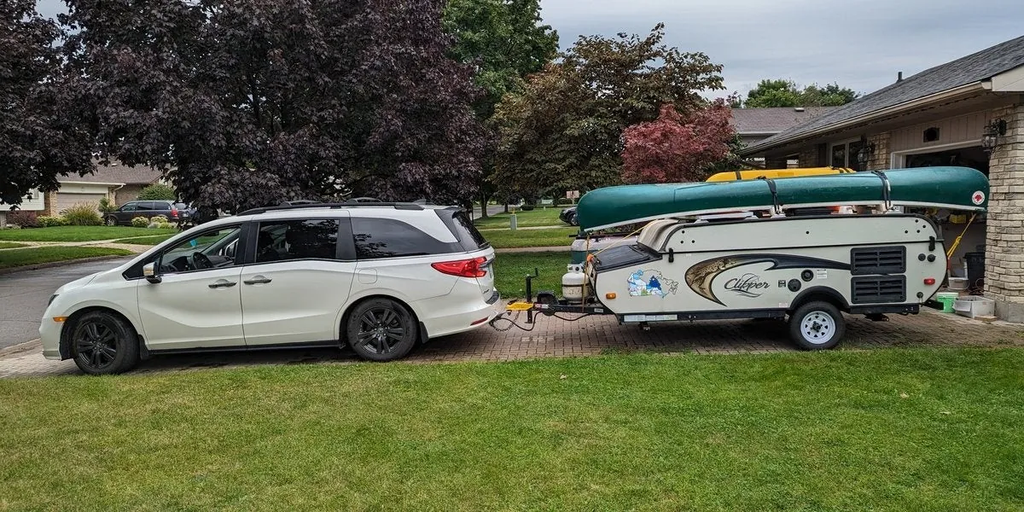
The Honda Odyssey has a maximum towing capacity of 3,500 pounds when properly equipped.
The term “properly equipped” means your van must have the factory towing package installed. The factory package includes a stronger radiator, a transmission cooler, and a reinforced frame hitch.
| Item | Weight Contribution | Notes |
|---|---|---|
| Dry Camper Weight | Varies (2,000–3,200 lbs) | The weight of the trailer as built at the factory, with no fluids or gear. |
| Fresh Water | 8.3 lbs per gallon | A 20-gallon tank adds over 160 pounds instantly. |
| Propane | 4.2 lbs per gallon | Two standard 20-lb tanks add roughly 40 pounds of fuel weight. |
| Cargo & Gear | 200–500 lbs | Clothes, food, tools, and outdoor equipment accumulate quickly. |
| Tongue Weight | 10% of Total | The downward force on the hitch ball; must be counted in the total. |
Warning: Never guess the weight of your loaded camper. You must drive onto a public vehicle scale to get the exact number before your first trip.
How Do You Calculate Real Trailer Weight?
Calculating the real weight requires more than reading the brochure from the camper dealer.
Start by finding the dry weight of the specific camper model you want. Most campers carry two.
Then consider your cargo. If you have a bicycle rack on the back of the van or the trailer tongue, include that weight too. Finally, you must account for tongue weight. This is the downward pressure the trailer tongue exerts on the hitch ball. It should be between 10% and 15% of the total trailer weight. While this presses down on the van, it’s part of the total mass the engine must move and the brakes must stop.
Is a Brake Controller Required for Safety?
You’ll almost certainly need a trailer with its own braking system. The minivan’s brakes alone can’t safely stop a 3,500-pound trailer, especially when going downhill or during sudden stops.
The factory towing package for the Odyssey typically includes a pre-wired connector for a brake controller, but the controller unit itself is often sold separately. You must install a proportional brake controller inside the cabin. This device senses how hard you’re pressing the van’s brake pedal and applies the trailer brakes with matching intensity. Without this synchronization, the trailer will push against the van, causing jackknifing or loss of control.
Some modern campers come with electric brakes built into the axles, while older or very light models might use surge brakes. Surge brakes activate hydraulically when the trailer pushes forward against the hitch during deceleration.
While surge brakes don’t require an electronic controller in the van, they can be less responsive than electric systems and may not work well if the trailer is lightly loaded. For the heaviest loads near the 3,500-pound limit, electric brakes with a proportional controller offer the safest performance.
Always check the specific laws in the states where you plan to travel. Some states have strict requirements for breakaway switches as well. This is a small battery-powered device attached to the trailer that automatically locks the trailer brakes if the trailer accidentally detaches from the van. It prevents a runaway trailer from careening down the road. Given the potential weight of a fully loaded camper, this safety feature is essential and often legally mandatory.
10 Best Food for Camping Without Fridge Picks (Easy & Delicious Ideas)
What Campers Fit the Honda Odyssey Best?
The 3,500-pound limit excludes many popular travel trailers. Look for models designed for light-duty towing. These are often called “teardrop trailers,” “micro campers,” or “lightweight travel trailers.” They sacrifice interior space and amenities to keep the weight down. If you prioritize mobility and fuel efficiency over luxury, these units pair perfectly with the Odyssey.
Teardrop trailers are the safest bet. They usually weigh between 1,000 and 1,800 pounds dry. Even fully loaded, they rarely exceed 2,200 pounds. This leaves plenty of margin for error and reduces strain on the minivan’s transmission. These trailers typically offer a sleeping area in the rear and a small kitchen galley at the back door. They don’t have standing room or indoor bathrooms, but they’re easy to tow and park.
Lightweight travel trailers with wet baths are the next option. A “wet bath” combines the toilet and shower in one small waterproof room. These units can range from 2,200 to 3,000 pounds dry. You must be extremely careful with water and cargo weights here.
Filling the water tank completely might push you over the limit. Many owners of these trailers travel with partially filled water tanks and refill at the campsite to stay under the 3,500-pound cap. Look for models with aluminum framing and fiberglass walls, as these materials are lighter than traditional wood construction.
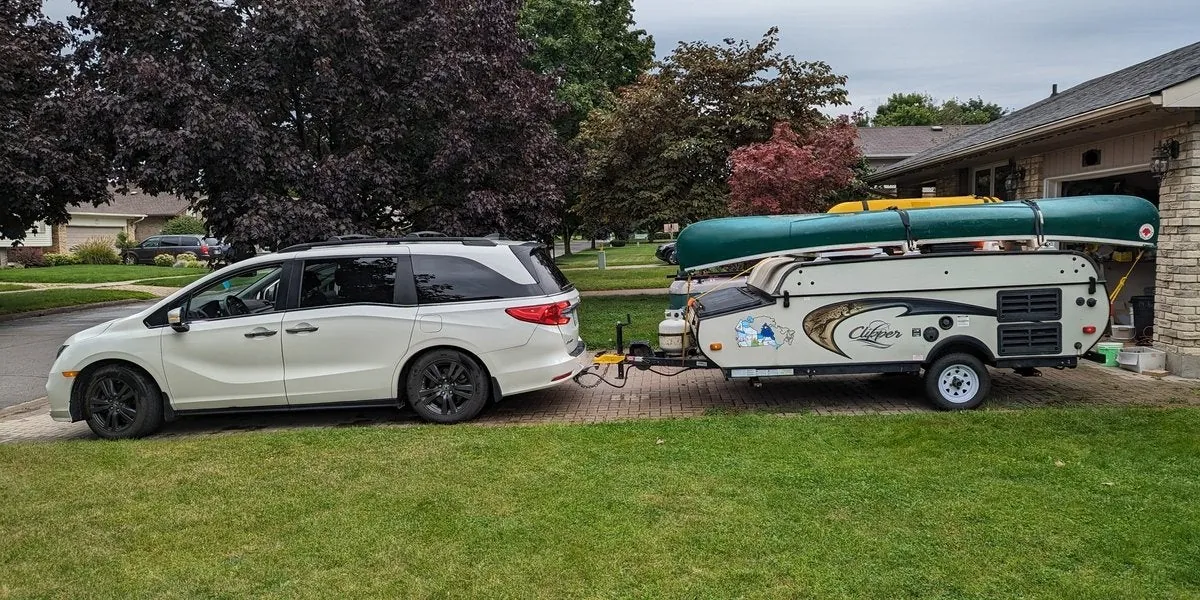
Pop-up campers, also known as folding trailers, are another excellent match. When closed for towing, they’re aerodynamic and low to the ground, reducing wind resistance. Their dry weight often falls between 1,500 and 2,500 pounds. Once at the campsite, you crank up the roof to create standing height and sleeping berths. Because they collapse, they’re less affected by crosswinds on the highway compared to boxy travel trailers. This makes them easier for a minivan to handle in bad weather.
Avoid campers with slide-outs. A slide-out is a section of the wall that extends outward to create more floor space. While convenient, the mechanism adds significant weight, and the expanded structure catches more wind. Most campers with slide-outs exceed 4,000 pounds, making them unsuitable for the Odyssey. Also, avoid fifth-wheel trailers or large hybrids. The hitch geometry of a fifth wheel requires a pickup truck bed, and the weight is far beyond what a minivan chassis can support.
| Camper Type | Typical Dry Weight | Loaded Estimate | Suitability for Odyssey |
|---|---|---|---|
| Teardrop Trailer | 1,000 – 1,800 lbs | 1,500 – 2,200 lbs | Excellent; leaves huge safety margin. |
| Pop-Up Camper | 1,500 – 2,500 lbs | 2,000 – 3,000 lbs | Very Good; aerodynamic and light. |
| Lightweight Travel Trailer | 2,200 – 2,900 lbs | 2,800 – 3,400 lbs | Good; requires strict weight management. |
| Hybrid Trailer | 3,000 – 3,800 lbs | 3,800+ lbs | Poor; likely exceeds limits even when empty. |
| Standard Travel Trailer | 4,000+ lbs | 5,000+ lbs | Impossible; don’t attempt to tow. |
Can You Tow Without the Factory Package?
Towing without the factory towing package isn’t recommended for loads approaching the maximum capacity. If your Odyssey doesn’t have the factory prep package, your towing rating is significantly lower. Attempting to pull a 3,000-pound camper with a non-equipped van invites catastrophic mechanical failure.
The primary difference lies in the transmission cooler. Towing generates immense heat in the transmission fluid. The standard radiator in a base-model Odyssey isn’t designed to dissipate this extra heat. Without an auxiliary cooler, the fluid temperature can spike, causing the transmission to slip, lose power, or seize up entirely. Repairing a damaged transmission costs thousands of dollars, often totaling the value of an older minivan.
Some owners try to solve this by installing an aftermarket hitch and a separate transmission cooler kit. While an aftermarket hitch provides the physical connection point, it doesn’t guarantee the vehicle’s computer systems are calibrated for towing. The factory package often includes changes to the engine tuning and stability control logic to accommodate trailer sway. Missing these software adjustments can make the van unstable when a heavy trailer pushes against it in windy conditions.
If you already own an Odyssey without the towing package, you have two choices. First, consult a Honda dealer to see if the factory components can be retrofitted. In some cases, this is possible, though labor costs may be high.
Second, strictly limit your towing to very light trailers under 1,000 pounds, such as small utility trailers or jet ski carriers. Don’t attempt to pull a full-sized camper. The risk of destroying your vehicle outweighs the convenience of using the van you already have.
It’s also worth checking your insurance policy. Some insurers may deny claims related to accidents if the vehicle was towing a load exceeding its rated capacity or if necessary safety equipment was missing. Proving you followed all manufacturer guidelines is essential for financial protection. If the manual states you need the towing package for loads over 1,000 pounds and you don’t have it, you’re driving outside of safety specifications.
What Are the Common Towing Mistakes?
Why Does the Van Feel Unstable at Highway Speeds?
Instability usually comes from incorrect tongue weight or poor load distribution. If the trailer is loaded too heavily in the back, the tongue becomes too light, causing the trailer to sway like a pendulum. This “tail wagging the dog” effect is dangerous and hard to control.
You must ensure 10% to 15% of the total trailer weight rests on the hitch ball. Move heavy items forward toward the axle to fix this. Also, check your tire pressure; underinflated tires on either the van or trailer worsen swaying.
How Do You Prevent Transmission Overheating?
Overheating happens when you tow in the wrong gear or ignore temperature warnings. Never tow in “Drive” (D) on long hills or in hot weather. Use lower gear selections via paddle shifters or the S-mode to keep the engine RPMs higher and reduce strain on the transmission.
This allows the fan to spin faster and cool the fluid better. If your dashboard has a transmission temperature warning light, pull over immediately if it glows. Let the engine idle to cool down before continuing.
What Happens If You Ignore Tire Load Ratings?
Using standard passenger tires instead of “Light Truck” (LT) or tires with a sufficient load index can lead to blowouts. The added weight of the trailer puts extra pressure on the van’s rear tires. Check the sidewall of your tires for the maximum load rating.
Ensure the sum of all four tire ratings exceeds the total weight of the van plus the tongue weight. Under-rated tires flex too much, generating heat that causes the rubber to separate and fail suddenly at highway speeds.
Why Is Fuel Economy So Much Worse Than Expected?
Towing a camper drastically reduces fuel efficiency, often cutting it in half. A Honda Odyssey might get 22 miles per gallon alone but only 11 to 13 miles per gallon while towing a heavy trailer. This is due to increased aerodynamic drag and engine load.
Drivers often mistake this for a mechanical problem, but it’s normal physics. Plan your trips with more frequent fuel stops and budget for higher gas costs. Running out of fuel in a remote area while towing is a major safety hazard.
Frequently Asked Questions
Can I tow a camper with a front-wheel-drive van?
Yes, the Honda Odyssey is front-wheel drive and can tow campers within its limit. Front-wheel drive aids wet-road traction, but steep ramps may cause wheel slip. Keep tongue weight at 10-15% to prevent front-end lift and maintain steering control.
Does the 3,500-pound limit include passengers?
No, the 3,500-pound towing capacity is separate from the payload capacity for passengers and cargo inside the van. However, both limits draw from the same Gross Combined Weight Rating (GCWR). You must ensure the total weight of the van, passengers, internal cargo, trailer, and trailer cargo doesn’t exceed the GCWR specified in your owner’s manual. Overloading the van internally reduces the amount of weight available for towing safely.
Is it safe to tow in mountainous terrain?
Towing in mountains is safe if you manage speed and use lower gears. The 3.5-liter V6 slows to 40-50 mph on steep inclines with a 3,500-pound load. Use engine braking downhill to prevent brake fade and avoid extreme grades when possible.
What hitch class do I need for this setup?
You need a Class II or Class III hitch receiver for towing. A Class II hitch handles the Odyssey’s 3,500-pound maximum, while a Class III offers a stronger 2-inch tube. Ensure the hitch bolts directly to frame rails to handle torsional stress.
Can I add a sway control device?
Yes, adding a weight-distributing hitch with sway control is highly recommended for loads over 2,000 pounds. These systems distribute the tongue weight across all axles of the van and trailer, improving stability and leveling the ride height. They also dampen side-to-side motion caused by wind or passing trucks. While the Odyssey has built-in stability assist, a mechanical sway bar provides an extra layer of security for heavier trailers near the maximum limit.
Do I need special mirrors for towing?
You must install extended towing mirrors if the camper blocks your standard rear view. Law requires seeing 200 feet behind the trailer’s side to spot passing vehicles and obstacles. Driving without adequate visibility is both illegal and dangerous due to blind spots.
Conclusion
You’ll want to visit a certified hitch installer next to ensure your setup matches the vehicle’s limits safely. They’ll confirm everything’s compatible so you don’t risk damage on the road. It’s a small step that’ll give you real confidence before your first camping trip together.