How Does a Camper Fridge Run on Propane: The Cooling Process
A camper fridge can run on propane by burning the gas to create heat, which powers a chemical cycle that pulls warmth from the interior and vents it outside.
Key Takeaways
- RV absorption refrigerators rely on a heat-driven chemical process involving ammonia, water, hydrogen gas, and sodium chromate rather than an electric motor.
- Liquid propane flows through a tiny brass orifice and burns at a small burner jet to generate the heat that kickstarts the cycle.
- The system relies strictly on natural thermal buoyancy and gravity, meaning your rig must stay parked within three degrees of level to avoid permanent hardware damage.
- A standard twenty-pound cylinder typically powers a mid-sized unit continuously for roughly three to four weeks under moderate ambient temperatures.
- Annual preventative maintenance, including blowing out the flue tube and scrubbing burner rust with an abrasive brush, prevents incomplete combustion and carbon monoxide hazards.
How Camper Absorption Refrigeration Works
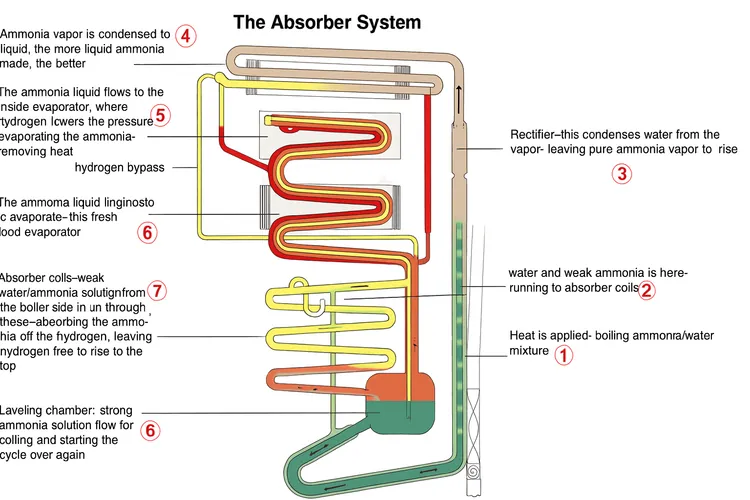
Traditional kitchen refrigerators use a compressor to pump freon through expansion valves. Camper units instead utilize a gas absorption cycle, an ingenious thermodynamic system patented in the 1920s by Swedish inventors Baltzar von Platen and Carl Munters.
Commercial manufacturers such as Dometic and Norcold refined this design specifically for mobile recreation because it operates seamlessly without alternating-current utility power.
The sealed circuit contains four distinct substances operating under high internal pressure:
- Pure ammonia, which acts as the physical refrigerant vaporizing at sub-zero temperatures.
- Demineralized water, which serves as the absorbing solvent liquid.
- Pressurized hydrogen gas, which lowers the partial vapor pressure across the ammonia pool.
- Sodium chromate powder, which coats the interior steel pipe walls to halt internal rust.
A propane flame heats the vertical steel boiler assembly. This separates the ammonia from the water, sending vapor upwards. The ammonia gas condenses at the top fins and drops into the cooling cabinet to meet hydrogen gas.
| Cycle Stage | Primary Location | Chemical State | Mechanical Action |
|---|---|---|---|
| Boiling & Separation | Boiler / Generator Tube | Ammonia-Water Solution | Propane flame applies heat, boiling ammonia into vapor |
| Condensation | Upper Exterior Condenser Fins | Ammonia Vapor to Liquid | Ambient outdoor air cools gas back into pure liquid |
| Evaporation (Cooling) | Freezer & Interior Fin Arrays | Liquid Ammonia + Hydrogen | Ammonia evaporates, pulling heat out of the food box |
| Absorption | Lower Absorber Coil Tank | Dilute Ammonia Solution | Water strips ammonia vapor out of hydrogen gas |
| Return | Gravity Drainage Siphon | Concentrated Liquid Mixture | Dense fluid flows down to repeat the boiling cycle |
How Does a Camper Fridge Run on Propane?
Gas infrastructure begins at your RV’s propane tanks. Regulators drop the tank cylinder pressure down to an operating level of eleven inches water column, which equals roughly 0.4 pounds per square linear inch. Fuel flows through underbelly piping into the exterior access compartment.
When the interior thermostat calls for cooling, a dual-solenoid 12-volt gas control valve opens. Propane travels into a brass housing and pushes through an ultra-fine laser-drilled orifice.
Simultaneously, the refrigerator control module pulses an electrical discharge through an igniter electrode, creating a repeated high-voltage spark. As the gas ignites, a sustained flame sits centered directly beneath a spiral steel sheet metal strip called a flue baffle.
A safety device—either an analog thermocouple or a modern flame-sensing spark electrode—sits submerged inside the outer flame cone. If the flame blows out due to highway turbulence or a wind gust, this sensor drops voltage within seconds, directing the safety valve to shut off fuel delivery to avoid flammable gas pooling.
The Vital Role of Gravity and Leveling
Absorption refrigerators rely on gravity to circulate chemicals through sloped tubing.
When the liquid ammonia stops flowing, the boiler pipe dries out while the propane flame continues to throw intense heat at the metal casing. This heat causes the sodium chromate inhibitor to crystallize into solid flakes.
Warning: Never operate an absorption refrigerator when the camper is parked more than three degrees off-level side-to-side or half a bubble off on a standard bubble level. Permanent chemical crystallization can occur within thirty minutes of off-level operation under a lit propane flame.
Fuel Consumption and Electrical Needs
Many new RV owners assume that selecting the gas setting allows their refrigerator to operate entirely off-grid without any battery reserves.
Fortunately, liquefied petroleum gas packs an exceptionally dense energy payload. One pound of LP gas contains roughly 21,500 BTUs of heat. Standard RV refrigerators consume 800 to 1,800 BTUs per hour, depending on ambient conditions and volume.
| Fridge Size | Typical BTU Rating | Hourly Burn Time (Avg.) | 20-lb Tank Lifespan (LP Only) | 12V DC Battery Draw |
|---|---|---|---|---|
| Small (3–4 cu. ft.) | 900 BTU/hr | 30 to 45 minutes / hr | 35 to 45 Days | 0.4 to 0.8 Amps |
| Mid-Size (6–8 cu. ft.) | 1,400 BTU/hr | 35 to 50 minutes / hr | 22 to 30 Days | 0.5 to 1.2 Amps |
| Large (10–12 cu. ft.) | 1,800 BTU/hr | 40 to 55 minutes / hr | 16 to 22 Days | 0.8 to 1.8 Amps |
| Residential Style (18+ cu. ft.) | N/A (Compressor) | Continuous Inverter Draw | Incompatible (Electric Only) | 8.0 to 15.0 Amps |
When camping in moderate weather, a standard six-cubic-foot unit cycles on and off, burning fuel roughly half the day.
7 Best Low Power Camping Fridge: Tested For Energy-Efficient
Propane Versus Other Power Modes
Camper refrigerators are traditionally categorized as either two-way or three-way units. A two-way appliance operates on 120-volt shore power or liquid propane. A three-way appliance adds a dedicated 12-volt direct current heating element to that list, allowing owners to run the cooling cycle using the engine alternator while towing down the highway.
Shore power bypasses fossil fuels entirely by energizing an electric sheathed cartridge element nestled against the boiler wall. This approach preserves your propane supply for cabin heating and cooking, but restricts comfortable usage to developed campgrounds with utility pedestals.
Lighting the Gas Burner Step by Step
Lighting an RV refrigerator on gas varies depending on whether your camper features an automatic electronic ignition board or a vintage manual piezo push-button sparker.
Step 1: Purge Trapped Line Air
Before touching the refrigerator panel, walk over to your camper stove, open your main tank valve, and light a cooktop burner for thirty seconds. Bleeding air through the stove burners pulls fresh fuel across the regulator, preventing the refrigerator’s orifice from passing air bubbles during startup.
Step 2: Establish Direct-Current Power
Verify that your camper battery disconnect switch is switched on and your house battery rests above 10.5 volts. The refrigerator’s control module, automatic valve coils, and spark ignition probes can’t activate without baseline 12-volt direct current power, even when burning bottled fuel.
Step 3: Select Gas Operating Mode
Press the main power button on the upper eyebrow control panel mounted between the doors. Set the mode switch from “Auto” to “Gas” or “LP.” On modern electronic systems, this command prompts an internal check: the control board opens the fuel solenoid and signals the electrode to click rapidly.
Step 4: Confirm Flame Establishment
Listen closely near the lower exterior refrigerator vent louver on the outside wall. Once burning, the panel check light or flame failure light turns off.
Step 5: Troubleshoot Lockout Modes
If the flame fails to ignite after roughly thirty seconds, the control board initiates a safety lockout to prevent unburned fuel accumulation. Persistent failures usually point to spider webs inside the burner tube or a corroded spark gap.
Troubleshooting Common Propane Fridge Problems
When an absorption refrigerator fails to maintain safe food storage temperatures on propane, the problem rarely lies within the factory cooling chemistry itself.
The Flame Refuses to Ignite
If the appliance sparks but produces no flame, confirm your tank actually contains liquid fuel and that the high-pressure excess flow safety valve inside the tank pigtail hasn’t tripped. Tripping happens when a cylinder valve is spun open too quickly against an unpressurized line. To reset it, close the cylinder valve completely, wait two minutes, and open the handwheel slowly to normalize line backpressure.
The Flame Lights but Goes Out
A flame that drops out after running for ten to fifteen seconds indicates a failed flame-sensing circuit. On older units, clean or replace the copper thermocouple assembly, ensuring the sensor bulb sits directly in the hottest part of the flame. On modern boards, verify the spark electrode wire is clean and grounded to the burner chassis.
Yellow Lazy Flames and Soot Accumulation
A clean-burning propane flame burns crisp, steady, and sharp blue. Airborne spiders love nesting inside mixing tubes, weaving thick webs that choke off oxygen delivery. Remove the burner bracket and run a flexible pipe cleaner through the tube to clear any debris.
Pro Tip: Never clear a clogged refrigerator burner orifice using sewing needles, metal wire, or drill bits. These precision discs have microscopic openings; using steel tools enlarges the hole, causing improper combustion and carbon monoxide generation. Soak the brass fitting in isopropyl alcohol and clear it with compressed air instead.
Maintenance and Safe Operation Practices
Propane appliances are safe when maintained properly, but using flammable pressurized gas in living quarters demands routine inspections.
Once per season, inspect the lower combustion assembly. Tap lightly on the sheet-metal flue chimney using a screwdriver handle; this dislodges rust flakes that peel off internal flue walls and fall down into the burner slots. Use a handheld vacuum or compressed air canister to clean the entire lower housing.
Always maintain active safety equipment inside the living quarters. The U.S. Consumer Product Safety Commission documents the severe risks associated with incomplete combustion and faulty exhaust venting, recommending regular testing of carbon monoxide detectors alongside LP gas leak alarms.
Periodically mix a solution of two tablespoons of liquid dish soap with warm water and brush it across every brass threaded joint leading to the refrigerator control valve. If growing bubbles appear, shut the tank valves off immediately and tighten the flare fittings using two opposing flare-nut wrenches.
Driving With Propane Turned On
Few topics spark more debate across the RV community than towing with the propane valve open to keep groceries cold on the road. The practice offers convenience, but introduces distinct safety risks that every owner must evaluate carefully.
Operating the appliance while rolling maintains cold food temperatures on long trips. It also prevents the chemical pooling issues common when parked off-level, as trailer swaying keeps the liquid solutions moving downward naturally.
However, towing with pressurized gas introduces real hazards. If an accident ruptures a line, gas vents uncontrollably. Blown tires can slice through copper propane lines.
Furthermore, pulling into a service station with open flames burning inches from your camper wall creates a fire risk. Fuel vapors can ignite if drawn into the refrigerator’s burner intake.
If you choose to run the refrigerator on gas while towing, develop a strict routine of turning the appliance off at the camper door before pulling up to any gas station pump island. Alternatively, place frozen water bottles inside the fresh food cabinet and leave the gas supply turned off at the tanks until you arrive safely at your campsite.
Frequently Asked Questions
Can I run my RV fridge on propane while driving?
Yes, it’s mechanically possible, but it carries safety risks. High winds can blow out the burner flame, road debris can sever lines, and operating open flames near gas station fuel islands creates severe fire hazards. Many travelers prefer chilling the unit completely overnight before departure, then keeping the doors sealed tightly during travel with the gas tanks closed.
How much propane does an RV fridge use in 24 hours?
A standard six-to-eight-cubic-foot absorption refrigerator burns between one-third and one pound of liquid propane every twenty-four hours under average summer temperatures. This means a standard twenty-pound LP tank can power the refrigerator continuously for three to four weeks, assuming you aren’t simultaneously running a water heater or cabin furnace from the same tank supply.
Why won’t my camper fridge stay cold on propane?
Common culprits include an unlevel camper frame, an obstructed burner tube choked by insect nests, a soot-fouled chimney flue, or an open flame that drops out due to a faulty thermocouple.
Do I need a battery if I run the fridge on propane?
Yes, modern absorption refrigerators can’t operate on propane without a connected 12-volt direct-current power supply. Your camper’s house battery powers the control board, gas solenoid valves, flame sensors, and thermostat switches. If the battery bank drains completely, the refrigerator shuts off its gas delivery immediately as a safety precaution.
How long does an RV fridge take to get cold on gas?
Absorption refrigerators cool down much more slowly than residential motor compressor units. When starting with a warm box at ambient summer temperatures, expect the freezer compartment to take four to six hours to drop below freezing, while the main fresh food compartment requires eight to twelve full hours to reach safe food preservation levels below forty degrees Fahrenheit.
Inspect your refrigerator’s exterior burner compartment, clean any rust or insect debris from the burner tube, and level your rig before your next outing.
Conclusion
Since these systems rely on a perfectly level surface to circulate the cooling fluid, you’ll want to check your RV’s balance whenever you park. It’s a simple habit that keeps your fridge running efficiently. If you’re ever unsure about your setup, don’t hesitate to consult your owner’s manual for specific leveling tips.