Stop Buying Ice: The Ultimate Camping Fridge Buying Guide
A cold drink at sunset can lift your mood after a long hike. Fresh food can turn a simple camp into a sweet memory. A camping fridge makes both easy. It keeps food safe and drinks cold without daily ice runs. No melting mess. No soggy bread. Just reliable cold, wherever you park your chair and watch the sky. This guide shows you how a camping fridge works, how much power it uses, and how to choose the right one for your trips. You will also learn how to pack it, power it, and keep it cold when the sun is hot. By the end, you will know if a camping fridge is worth it for you—and which size and type fits your style.
What Is a Camping Fridge and How Does It Work?
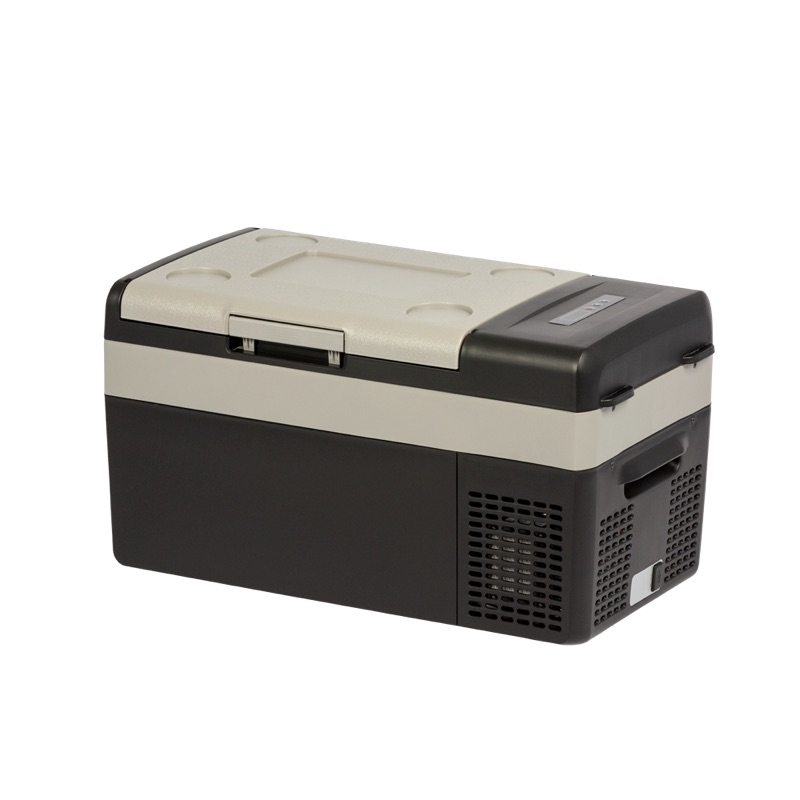
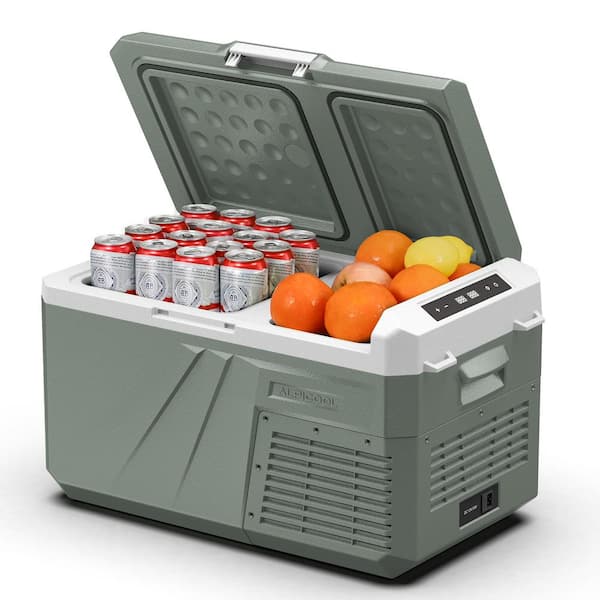
A camping fridge is a portable refrigerator built to run on 12V DC power, 24V DC, or AC power. It is made for cars, vans, RVs, boats, and tents. It uses three possible cooling methods: compressor, thermoelectric, or absorption. A compressor fridge is the most common and most efficient. Most models look like rugged coolers with a lid and handles. Many can also freeze, which is a big upgrade from ice-filled coolers. You get steady temperatures, even in heat or on rough roads. You also get better food safety on longer trips.
Camping fridge vs. traditional cooler
A cooler uses ice. A camping fridge makes its own cold. This is the key change. With a cooler, your food gets wet as ice melts. You also lose space to ice bags. You must buy or make ice often. A cooler can work for a day or two, but it is hard to keep safe temps beyond that. A camping fridge gives you control. You set a number and the fridge holds it. No melt. No rush to town. It is better for long trips and remote sites.
A cooler is cheap and simple, though. It has no wires. It never fails. It can be best for quick trips, or if you camp in cool weather. But if you camp in heat, or like fresh meat and dairy, a fridge is a game-changer. It removes stress and food waste. It can even save money over time if you always buy ice.

60L: How a compressor camping fridge works
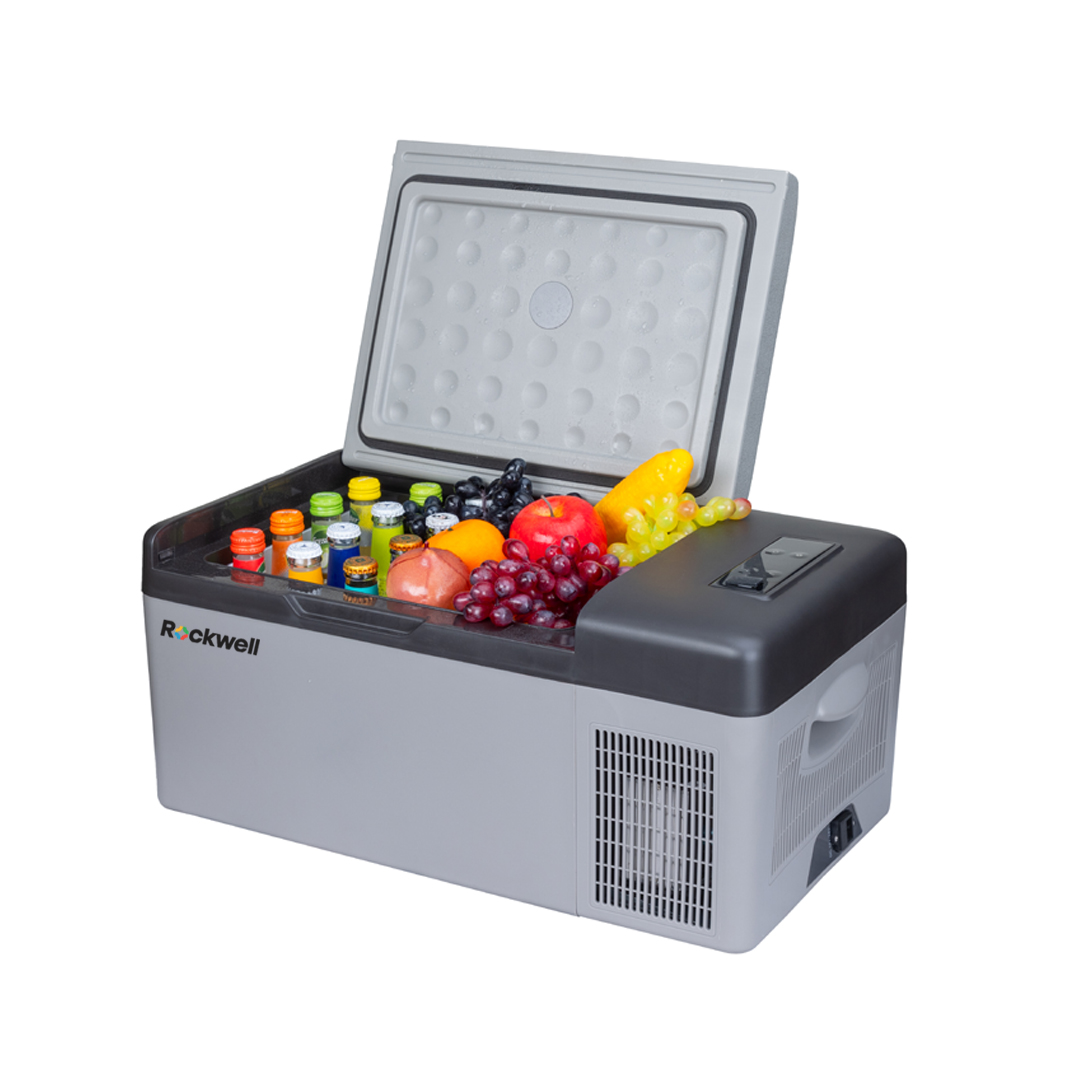
A 60-liter compressor fridge works like a small home fridge. A sealed compressor pushes refrigerant through tubes. The refrigerant absorbs heat inside the cabinet, then dumps that heat outside through a condenser. A fan moves air over the condenser to help this step. The system cycles on and off to hold the set temp. Good insulation around the cabinet slows heat coming in. A decent 60L unit has thick walls, a tight lid seal, and smart control logic.
Why 60L? That size is popular for family trips and long weekends. It can hold a week of food for two, or three days for four. The compressor can run on 12V power from a car, a leisure battery, or a power station. Better units use efficient compressors like Secop (Danfoss) or LG. These sip power. Many have a soft start and speed control to save energy. They also have low-voltage cut-off to protect your battery.
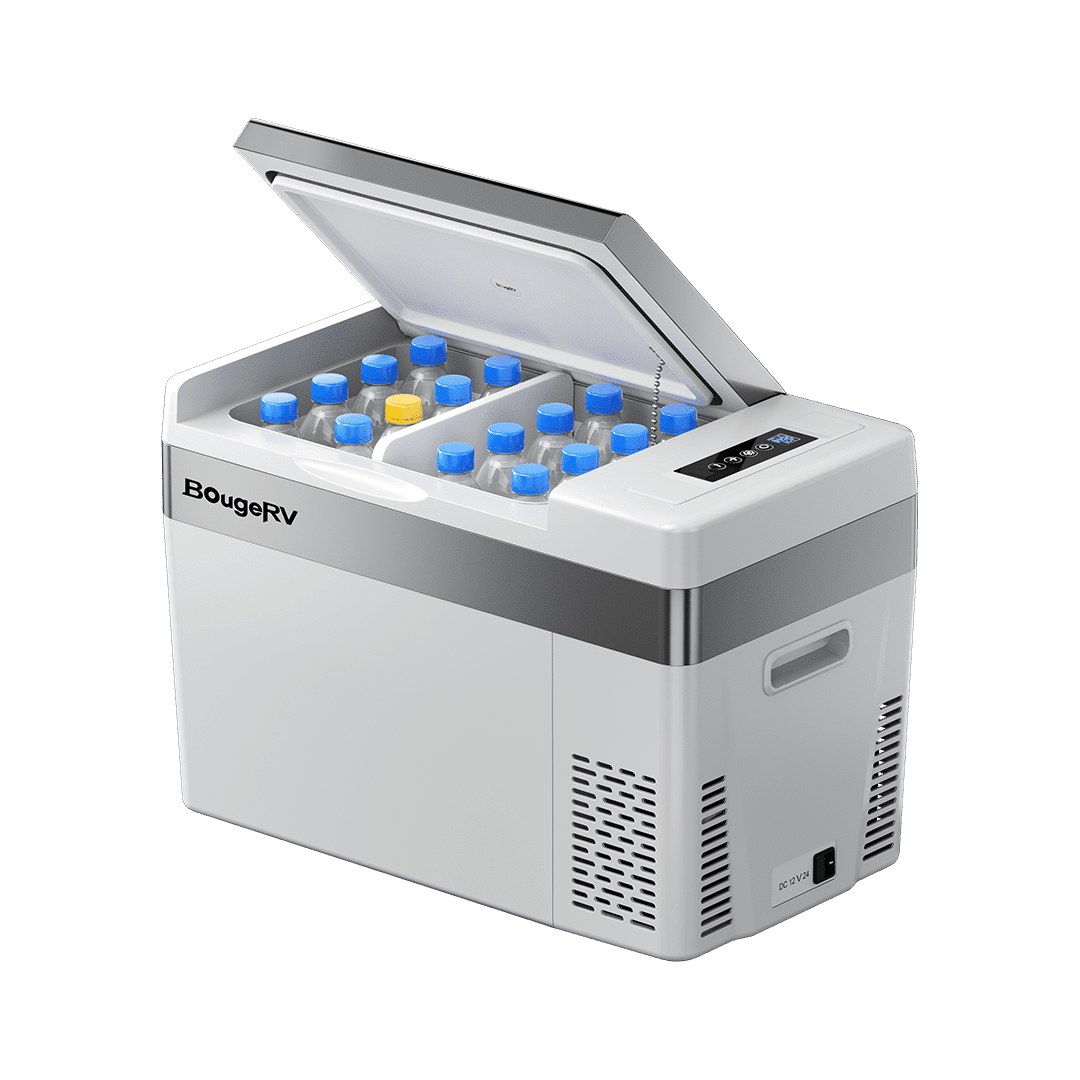
Can a camping fridge also be a freezer?
Yes. Most compressor fridges can freeze. Set it to 0°F (-18°C) and it will hold it, if the ambient temp is not extreme. Many dual-zone models can run one side as a fridge and the other as a freezer at the same time. That lets you bring ice cream to the desert or keep meat frozen for later in the week. Thermoelectric and absorption units are not good freezers. They struggle to drop much below ambient temp, especially in heat.
Keep in mind: freezing uses more power than chilling. It also demands better insulation and steady airflow around the unit. If you plan to freeze, size your battery or power station with margin. Also pre-freeze food at home. This saves a lot of energy on day one.
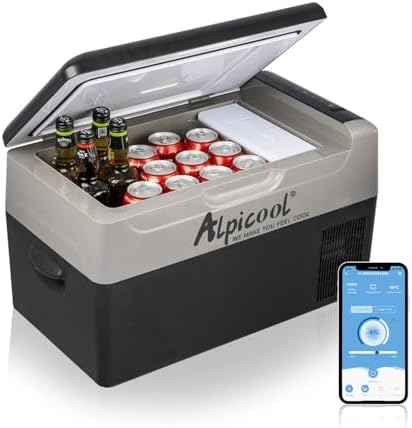
Where can you use a camping fridge?
You can use a camping fridge in many places:
- Car camping sites with or without hookups
- Campervans and RVs on 12V or shore power
- Boats and overland rigs
- Tailgates, picnics, and sports days
- Cabins, tiny homes, and off-grid shacks
- Power outages at home as a backup
A camping fridge is robust and portable. It has tie-down points and a lid that stays put on bumpy roads. It runs from a cigarette lighter, Anderson plug, or AC wall outlet with an adapter. Just make sure it has airflow and stays out of standing water. Then it will hum along in most places you travel.

What Are the Main Types of Camping Fridges?
There are three main types: compressor, thermoelectric, and absorption. Each has pros and cons. Your choice depends on climate, power, budget, and food needs. If you camp in hot weather or go off-grid, a compressor fridge is often best. If you want a quiet, gas-powered option for a camper, absorption can work. If you just need to cool drinks a bit on day trips, a thermoelectric cooler may be enough.
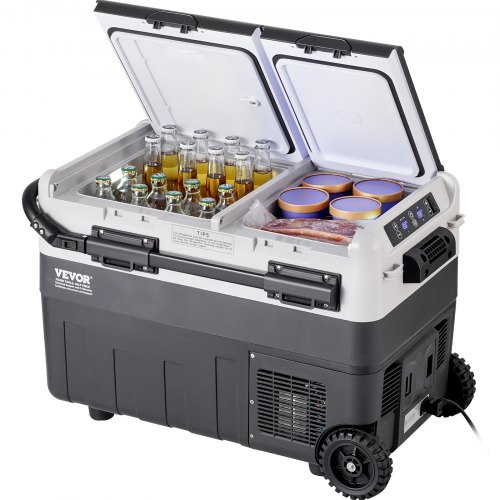
Compressor camping fridge
A compressor fridge is the gold standard. It can cool and freeze in heat. It holds steady temps. It uses power well. It has a real thermostat. It can run on 12V DC, 24V DC, and many also include an AC adapter. Brands often use Secop or similar compressors. These units are rugged and field-proven. Many off-roaders use them for days at a time.
Pros:
- True refrigeration and freezing
- Efficient at 12V
- Reliable in heat and on rough roads
Cons:
- Higher price
- Some compressor noise
- Needs airflow and clean power
Thermoelectric cooler
A thermoelectric cooler uses a Peltier module. It moves heat when you apply power. It has no compressor or refrigerant. It is quiet and cheap. But it cannot chill far below ambient. If it is 90°F outside, many will only cool to about 50–60°F. That is not safe for meat or dairy for long. It works best for drinks and short trips in cool weather. It is simple and light.
Pros:
- Low cost
- No moving parts, near silent
- Can heat or cool with a switch
Cons:
- Poor performance in heat
- High power draw for little cooling
- Not safe for long-term food storage
Absorption refrigerator
An absorption fridge uses heat to drive the cooling cycle. It can run on propane, 12V DC, or 120V AC. You often see these built into RVs. They are silent. They have no compressor. They can run for days on a small propane tank. But they are slow to cool, and they struggle in hot weather. They also must sit level to work well. Many campers still like them for long stays with propane. But for vehicles in motion and hot climates, a compressor fridge wins.
Pros:
- Silent
- Can run on propane for long periods
- Good for stationary RV use
Cons:
- Not great in high heat
- Slow to cool, needs level ground
- Bulky and less efficient on 12V
Single-zone vs. dual-zone camping fridge
A single-zone fridge is one chamber with one temperature. You set it to fridge temps or freezer temps. It is simple and usually cheaper. A dual-zone fridge has two chambers. Each has its own control. You can set one to fridge and one to freezer. This doubles your options. It is great for families or long trips. But dual-zone units cost more and use a bit more power.
Ask yourself: Will you ever need to freeze and chill at once? If yes, dual-zone is worth it. If not, a single-zone is lighter and simpler.
What Size Camping Fridge Do You Need?
Size depends on the length of your trip, the number of people, and how you shop and cook. Volume is measured in liters (L). Think of 1 liter as a bit bigger than a quart. To visualize, a 12-pack of cans is about 9 liters. Food with odd shapes can waste space. Baskets help. Always check inside dimensions, not just liters.
15–20L camping fridges
This is a compact size for solo trips, day trips, or a couple who packs light. It holds drinks, a few meals, and some snacks. It fits small cars and even the front seat. It is light to carry and uses less power. But it will feel tight on a three-day trip if you bring meat and produce.
Best for:
- Solo weekend warrior
- Minimalist cooler upgrade
- Drink chiller
20–30L camping fridges
This is the sweet spot for many couples. It holds food for two to three days. You can stand some bottles upright. It fits in a trunk. It is not too heavy to lift when full. It is still compact, so it sips power. If you keep a simple menu, it can cover a long weekend.
Best for:
- Couples on weekend trips
- Drinks and basic food for small groups
- City cars and compact SUVs
30–40L camping fridges
This is the best all-rounder for two to four people on a weekend. It can also cover a week for two. It can hold tall milk jugs and a lot of produce. It gives more flexibility for meal plans. Many dual-zone models start at this size. It is heavier. Make sure you can lift it when full.
Best for:
- Small families
- Trips of three to five days
- People who like to bring fresh food
40–60L camping fridges
This range is ideal for families or long weekends. A 50L unit is a classic choice for overland rigs. It can hold enough for four people for three to four days. It can also run one side as a freezer if dual-zone. It does draw more power. You may need a second battery, a power station, or solar. Tie-downs and a slide help with access in SUVs.
Best for:
- Families and friend groups
- Mixed fridge/freezer use
- Week-long trips for two
60L+ camping fridges
These are big, often for big families, boats, or long trips. They are heavy and take space. They can be wonderful as a base-camp fridge or in a van with storage. They work well if you stock up for a week or more. But plan your power carefully at this size. A 75–95L unit makes sense in a van build, not a small car.
Best for:
- Long overland trips
- RVs and campervans
- Big groups or long base-camps
How to measure your available space
Measure the space in your car, van, or RV where the fridge will sit. Check length, width, and height. Add room for ventilation. Most units need at least 2–4 inches of space on the compressor side. Account for lid swing if it opens from the top. If you plan a slide, add the slide’s height and travel. Check door sizes. A fridge must fit through the tailgate. Don’t forget weight. Can you lift it when full? Two side handles help with team lifts.
How Much Power Does a Camping Fridge Use?
Power use depends on fridge type, size, set temp, ambient heat, airflow, and how often you open the lid. Compressor fridges use the least power per cooling. Thermoelectric units can draw a lot but do not cool well. You need to understand watts, amps, and amp-hours to plan a safe setup.
Understanding watts, amps, and amp-hours
- Volts (V): The push from your battery. Most car systems use 12V DC.
- Amps (A): The flow of current at a moment.
- Watts (W): Power. Volts times amps (V × A = W).
- Amp-hours (Ah): Battery capacity. One amp for one hour is 1 Ah.
A fridge may draw 4 amps when the compressor runs. But it cycles on and off. The average draw over a day may be much lower. Battery capacity is often in Ah (12V lead-acid) or Wh (watt-hours) for power stations. Convert Wh to Ah at 12V by Wh ÷ 12 ≈ Ah.
What affects camping fridge power consumption?
Key factors:
- Ambient temperature: Hotter air raises duty cycle.
- Set temperature: Freezer mode uses more than fridge mode.
- Insulation and cover: Good insulation saves power.
- Airflow: Restricted vents make the compressor work harder.
- Lid openings: Warm air rushes in each time you open it.
- Food mass: Full fridges hold temp better than empty ones.
- Start-up temp: Warm food takes lots of energy to cool.
Small habits pay off. Pre-chill food. Keep the fridge out of the sun. Use a cover. Group items so you can grab and go. The fridge will run less and draw less power.
How to estimate daily energy use
Find the average amp draw from the spec sheet, or estimate from user reports. Many 30–50L compressor fridges average 0.8–2.0 Ah per hour at 12V under mild conditions. Multiply by 24 hours to get daily Ah. For example, 1.2 Ah/h × 24 = 28.8 Ah per day. Convert to Wh by multiplying by 12V: 28.8 Ah × 12V ≈ 346 Wh per day. Add 10–20% to cover hot days and door openings.
If you plan to freeze, double-check the numbers. Freezing can push the average to 2–3 Ah/h in heat. Every setup is unique. Always plan a buffer.
Example camping fridge power calculation
Trip: 3 days, 40L compressor fridge set to 37°F. Ambient 86°F. Average draw measured by users is 1.5 Ah/h. Daily use: 1.5 × 24 = 36 Ah. Over 3 days: 108 Ah. On a 12V system, that is about 1,296 Wh.
Battery options:
- 100Ah AGM battery: Usable to 50% = 50Ah. Not enough for 3 days.
- 100Ah LiFePO4 battery: Usable to 90% = 90Ah. Still short.
- 150Ah LiFePO4: Usable ~135Ah. Enough with margin.
Add 100–200W of solar and you can stretch a 100Ah LiFePO4 for long trips. A 500–700Wh power station could cover one to two days, or longer with solar input.
What Power Source Is Best for a Camping Fridge?
You can run a camping fridge from a 12V car socket, a portable power station, a leisure battery, shore power, or solar. The best choice depends on trip length and driving time. For day trips, a car socket is fine. For weekends, a power station or second battery is safer. For long trips, combine battery and solar.
Running a camping fridge from a 12V car socket
This is the simplest option. Plug it in and drive. Most fridges come with a 12V cord. But a car socket may shut off when the engine is off. Then the fridge stops. Also, thin factory wiring can sag voltage. Over the long term, a direct line to the battery with a fuse is better. Use a good socket or Anderson plug rated for the fridge’s draw.
Best for:
- Day trips
- Short drives between camps with fridge off overnight (with ice packs)
- Testing the fridge before a bigger setup
Using a portable power station
A power station is a battery with built-in inverter, DC ports, and a screen. It is simple and safe. You can charge it from AC, car, or solar. Many have a regulated 12V output that is ideal for a fridge. You can see exact input and output power. It is easy to size your needs. Pick one with a 12V socket that can deliver the peak amps your fridge needs at start-up.
Pros:
- Plug-and-play
- Solar-ready
- Good monitoring
Cons:
- Cost per Wh can be high
- Heavy at higher capacities
- Must keep it out of heat and water
Using a leisure battery
A leisure battery (often AGM or LiFePO4) is common in campervans and overland rigs. It is installed with a DC-DC charger or split-charge relay. The DC-DC charger tops up the battery when you drive. You can also add solar with an MPPT controller. A simple fuse box powers the fridge and lights. This setup is robust. It works for long trips and deep off-grid use.
Tips:
- Use LiFePO4 if budget allows. It is lighter and has more usable capacity.
- Add a low-voltage disconnect to protect the battery.
- Size cables for the fridge’s current and the run length.
Can solar panels run a camping fridge?
Yes, but solar is a daytime helper. It does not run the fridge at night. You need a battery to store the energy. A 100W panel can add about 300–500Wh per sunny day, depending on location and season. That can cover the daily use of a medium fridge in mild weather. Use a good controller. Place panels early and keep them in the sun. Use adjustable legs for tilt. If you park in shade, run a long cable to place panels in the sun.
Can a Camping Fridge Run Overnight Without Draining the Battery?
It can, if you size your battery well and keep the fridge efficient. Overnight is 8–12 hours of cooling with no charging. The fridge will cycle. The average draw depends on ambient temp, set temp, and how full it is. You can plan for a safe margin by using a real test at home. Chill the fridge, then run it on your battery. Check the power left in the morning.
What determines overnight battery life?
- Battery type and usable capacity
- Fridge efficiency and size
- Ambient temp and airflow
- How often you opened the lid in the evening
- Whether the battery started at 100%
As a rule, a 40L compressor fridge at 37°F uses 20–40Ah per 24 hours in mild weather. Overnight use may be 8–15Ah. A 100Ah LiFePO4 can handle that with ease. An older 70Ah starter battery is risky. You do not want to wake to a dead car.
How to reduce overnight power use
- Pre-chill food and the fridge
- Set a slightly warmer temp at night (39–41°F)
- Keep the lid closed as much as possible
- Use an insulating cover
- Park in shade
- Improve airflow around the compressor side
- Do not stuff the vents
Small steps can save big energy. A tidy fridge that stays closed stays cold.
Why low-voltage protection matters
Low-voltage cut-off protects your battery. When voltage drops below a set level, the fridge shuts off. This stops deep discharge, which can damage batteries. Many fridges have three levels of cut-off. Use the right one for your battery type. For a starter battery, set it higher. For a dedicated LiFePO4, you can set it lower. Read the manual. This feature can save your battery and your trip.
What Temperature Should a Camping Fridge Be?
The safe zone for most food is 34–40°F (1–4°C). Cold enough to slow bacteria, warm enough to avoid freezing produce. For drinks, you can go cooler. For meat and dairy, aim for 36–38°F. If you use part of the fridge as a freezer, set that zone to 0°F (-18°C).
Recommended temperatures for common foods
- Milk, yogurt: 36–38°F
- Raw meat and fish: 34–36°F (keep well sealed)
- Leafy greens: 38–40°F
- Eggs: 38–40°F
- Soft drinks and beer: 33–37°F (avoid freezing)
- Ice cream: -5 to 0°F
If your unit has uneven temps, place meat in the coldest spot. Many fridges are colder near the compressor. Use baskets to keep items in their zone.
Refrigerator vs. freezer settings
Fridge mode holds 34–40°F. It uses less power. It is best for most trips. Freezer mode holds 0°F. It uses more power and needs better planning. You can use dual-zone to run both. If you run a single-zone as a freezer, plan a second cooler or fridge section for fresh food. Rotate frozen meals to the fridge side a day before you cook.
Why you should use a fridge thermometer
The display may not tell the whole story. A simple thermometer lets you check the real temp in the food zone. It can show if warm air is pooling near the lid or in a basket. Put one probe in the warmest area. Check it after the lid has been closed for a while. If temps drift, adjust settings or airflow.
Camping food safety basics
- Keep raw meat sealed and low in the fridge
- Wash hands and knives after touching raw food
- Keep the lid closed to stay in the safe zone
- Cook to safe internal temps
- Chill leftovers fast in shallow containers
When in doubt, throw it out. Stomach bugs ruin trips.
How Do You Pack a Camping Fridge Properly?
Packing well saves power and time. It also keeps food safe. Think like a grocer. Heavy and cold items go low. Delicate items go high. Group by meal. Use bins and baskets to stack and separate. Label bags. Your future self will thank you when it is dark and you are hungry.
Pre-chill food before your trip
This step saves the most power. Chill or freeze items at home. Plug in the fridge to AC the night before. Set it to your trip temp. Load it cold. The compressor will work less on day one. Put ice packs on top to absorb warm air by the lid.
Organize food by meal and frequency of use
Put breakfast items near the top for quick grabs. Group day-one meals together in a bin. Drinks can go in a side basket. Label bags with the day. The less you dig, the less warm air you let in. This keeps temps steady and saves power.
Keep raw meat safely separated
Raw meat belongs in leak-proof bags or containers. Place it low in the fridge, where it is coldest. Keep it away from produce and ready-to-eat food. If you freeze meat, set a reminder to move it to the fridge the day before. Avoid juices dripping onto other food.
Avoid blocking internal airflow
Do not press bags against the inner walls or the evaporator plate. Leave some gaps for air to move. If the fridge has a fan inside, keep it clear. Overpacking can make hot spots. Use baskets to keep a tidy gap for air to flow.
How Long Does a Camping Fridge Take to Get Cold?
Most compressor fridges need 30–90 minutes to go from room temp to fridge temps. Freezer temps take longer. The time depends on size, starting temp, ambient temp, and airflow. A pre-chilled fridge cools very fast. Warm food slows it down.
Factors that affect cooling speed
- Starting temperature of the cabinet
- Ambient heat around the fridge
- Whether food is pre-chilled
- Airflow at the compressor and condenser
- Insulating cover use
On a hot day in the sun, a fridge can struggle. Move it to shade and give it air. It will catch up.
The fastest way to cool a camping fridge
- Pre-chill the empty fridge overnight on AC
- Load pre-chilled food fast
- Place cold packs on top
- Run it in the shade with good airflow
- Avoid frequent lid openings for the first hour
These steps can cut hours off the cool-down. Your compressor and battery will love you.
What to check if the fridge is not cooling
- Is it getting 12–14V under load?
- Are vents blocked or fans dirty?
- Is the lid seal dirty or damaged?
- Is the set temp correct?
- Is the unit in direct sun?
Use a voltmeter. Check fuses and connectors. Clean the condenser fins. If the compressor runs nonstop with no cooling, it needs service.
What Features Should You Look for in a Camping Fridge?
Look for features that fit how you camp. Pay for performance first. Fancy apps are nice, but cold food is the goal. Start with a good compressor, strong insulation, and a solid case. Then add convenience features if they help you.
Essential camping fridge features
- Efficient compressor (Secop or equivalent)
- Thick insulation and tight lid seal
- True temperature control with a real sensor
- Low-voltage protection
- Strong handles and tie-down points
- Interior baskets for airflow and organization
- Reliable 12V cord and connector
These are must-haves if you go off-grid. They add safety and value.
Useful convenience features
- Dual-zone control for fridge/freezer flexibility
- Bluetooth or app control
- Interior and exterior temperature displays
- USB ports for small devices
- Built-in battery (in some models) for short moves
- Removable lid or reversible hinges
- LED light inside for night use
These features make life easier. Some save power by reducing lid time.
Features that may not be worth paying extra for
- Built-in cup holders on the lid
- Oversized inverters in the fridge (use DC when possible)
- Fancy color screens that draw extra power
- Weak solar input claims without clear specs
Nice-to-haves can add cost and fail in the field. Put dollars into core build quality first.
Is a 12V Camping Fridge Better Than an Electric Cooler?
A 12V compressor fridge and an electric thermoelectric cooler serve different needs. The fridge is for safe, steady cold in any weather. The cooler is for short trips and drinks. If food safety or longer trips matter, the 12V compressor fridge wins.
Advantages of a 12V compressor fridge
- Holds safe temps in heat
- Can freeze if needed
- Uses less power per degree of cooling
- Better for meat, dairy, and long trips
It costs more up front. But it pays off with less waste and less stress. It is the right tool for real camping.
Advantages of an electric cooler
- Low purchase price
- Light and simple
- Quiet with no compressor
For beach days, picnics, or mild nights, a cooler is fine. If you never camp in heat and eat shelf-stable food, it may be all you need.
12V camping fridge vs. electric cooler comparison
- Cooling: Fridge can reach and hold 34–40°F or 0°F. Cooler often cools only 20–30°F below ambient.
- Power: Fridge uses power smarter. Cooler can draw steady power with poor results in heat.
- Food safety: Fridge wins by a mile.
- Cost: Cooler is cheaper upfront.
Choose based on your risk tolerance and trip length. If you want cold milk and safe meat in July, pick the fridge.
How Do You Choose a Camping Fridge for a Campervan or RV?
In a van or RV, a camping fridge is part of a system. It must fit a cabinet, tie into your power, and stay secure on the move. Think about access and weight. A slide helps with top-open lids. Ventilation is key. Many van builds cook near the fridge. Heat from cooking can raise the duty cycle. Plan the layout with airflow in mind.
Portable fridge for campervans
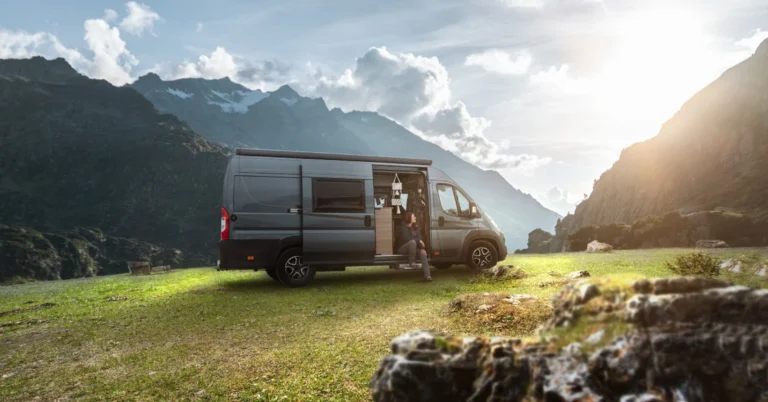
A portable fridge is flexible. You can move it. You can use it outside under an awning. You can switch vehicles. It is simple to install. You only need tie-downs, a 12V outlet, and room for air. Many van owners like a 40–60L portable unit on a slide. It offers more storage than a small built-in RV fridge.
Built-in RV refrigerator
A built-in unit looks clean and stays put. It often has a front door. Some are compressor types. Some are absorption units that can run on propane. Built-ins are great for full-time living. But they lock you into one location. They may need vents to the outside. They often cost more than a portable unit with similar volume.
Use an insulating cover Matching the fridge to your electrical system
An insulating cover on a portable fridge can cut power use. It shields the cabinet from hot air and sun. It also protects the case from scratches. Many brands sell covers that fit their models. They keep the lid seams clean and improve looks. In a van, where space is tight and heat builds, a cover helps a lot.
Match the fridge to your power system. Check peak and running amps. Make sure your DC-DC charger, wiring, and fuses are sized for the load. If you plan to freeze, add headroom. Pick LiFePO4 if you can. It is stable and has high cycle life. Tie everything to a clean fuse block. Label circuits. Test before the big trip.
How Do You Keep a Camping Fridge Cold in Hot Weather?
Heat is the enemy. When the sun bakes the car, the compressor works hard. This drains your battery fast. But you can fight back with good placement, airflow, shade, and insulation. Small tweaks can drop your duty cycle a lot.
Choose the right location
- Keep the fridge out of direct sun
- Avoid placing it next to the vehicle’s exhaust or a hot engine bay
- Leave space on the compressor side for airflow
- Use a slide or platform to lift it off a hot floor
Shade and airflow are free power savers. Aim a small 12V fan to move air if needed.
Use an insulating cover
A cover adds R-value. It slows heat into the cabinet. It also blocks radiant heat from windows. In the desert, a cover can be the difference between 30Ah and 50Ah per day. Make sure the cover does not block vents. Cutouts should match the fan side.
Avoid common hot-weather mistakes
- Do not leave the lid open while you prep food
- Do not set the temp lower than needed
- Do not stack gear against the vents
- Do not place warm pots or pans on the lid
Every mistake forces the compressor to run longer. Keep your process cool and calm.
How Noisy Is a Camping Fridge?
Most compressor fridges are quiet. You will hear a soft hum when the compressor runs. Some have fan noise. In a tent, this can be noticeable at night. In a van or RV, it is like white noise. Thermoelectric and absorption units are near silent. But they have their own trade-offs. If you are a light sleeper, pick a fridge with a quiet compressor and fan.
What creates camping fridge noise?
- Compressor vibration
- Fan noise at the condenser
- Cabinet rattles or loose handles
- Items inside knocking the walls
Good brands add rubber mounts and soft-start control. This reduces the thump when the compressor kicks on.
How to reduce compressor and vibration noise
- Place the fridge on a foam pad or rubber mat
- Tighten handles and screws
- Do not overpack items that push on walls
- Set the ECO mode at night if your unit has one
- Clean fans; dust makes fans loud
A few minutes of setup can make nights silent.
Is noise important for tent camping?
It can be. In a quiet forest, a hum stands out. Place the fridge a few feet from your tent. Use an extension for the 12V cable if needed. Or run it in the car with windows cracked for airflow. Most people get used to the sound. Still, plan ahead if you are sensitive.
How Much Does a Good Camping Fridge Cost?
Prices vary by size, brand, and features. Entry-level units can be under $300. Mid-range units run $400–$800. Premium models can hit $1,000–$1,400 or more. You get what you pay for with compressors, insulation, and build quality. But there are good values in the mid-range.
Entry-level camping fridges
These are small to mid sizes with simple controls. They may use generic compressors. They can work well for casual trips. Look for decent insulation, baskets, and low-voltage cut-off. Read user reviews about longevity. Warranty length matters.
Typical price: $250–$450 for 20–35L.
Mid-range camping fridges
These often have better compressors, thicker walls, and nicer features. Dual-zone options start here. App control is common. They balance cost and performance. This range suits most campers who go out often.
Typical price: $450–$800 for 35–55L.
Premium camping fridges
Top brands offer rugged cases, superb compressors, and great support. They add smart lids, high-efficiency condensers, and tight quality control. They last for years of hard use. They are expensive up front, but cheap per trip if you go often. In harsh places, support matters.
Typical price: $900–$1,400+ for 40–75L.
Additional costs to consider
- Insulating cover: $50–$200
- Slide or tie-down kit: $100–$300
- Second battery or power station: $300–$1,200+
- Solar panels and controller: $150–$600+
- Cables, fuses, and connectors: $30–$150
Plan the full system cost. A fridge without power is a lukewarm box.
What Are the Common Camping Fridge Mistakes to Avoid?
Many issues are easy to avoid. Most come from poor planning or packing. Learn from others and save your trip.
Buying the wrong size
Too small and you run to town often. Too big and you waste power and space. Think about how you cook. Do you bring fresh veg, or eat simple meals? Size for your longest typical trip, not the dream one. Use liters as a guide, but check inside layout. Baskets and tall bottle space matter.
Underestimating power requirements
Do not guess. Do the math. Then add a buffer. Hot weather and freezing will push your draw up. Test at home with your power source. See how long it lasts. Do not rely on a car starter battery overnight. That is the shortest path to a no-start morning.
Ignoring ventilation
Fridges need to breathe. If you cram one in a tight box, it will run hot and draw more power. Leave space on the fan side. Add a vent or small fan if building into a cabinet. Check for dust if you drive dirt roads. Clean fins and filters.
Loading warm food
Warm food is the number one power hog. It can take hours to pull down. Pre-chill or freeze at home. For last-minute items, put them in the home fridge early in the morning. Your camping fridge will thank you.
Relying only on the fridge display
The display is often close, but not perfect. Use a thermometer to spot-check the real temp where the food sits. Calibrate your set point if needed. If the display says 36°F but your milk reads 42°F, adjust or move items.
How Do You Clean and Maintain a Camping Fridge?
Clean and care keep your fridge safe and efficient. It also prevents smells. You do not need fancy tools. A soft cloth, mild soap, and a brush will cover most tasks. Make maintenance a habit after each trip.
Cleaning after every camping trip
- Unplug and empty the fridge
- Wipe the inside with warm soapy water
- Rinse with a damp cloth and dry with a towel
- Leave the lid open to air out
- Clean the gasket and drain plug
For smells, place a small tray of baking soda inside for a day. Do not use harsh chemicals. They can harm seals and plastics.
Preparing the fridge for long-term storage
- Clean and dry it well
- Prop the lid open a bit to prevent mold
- Store in a cool, dry place out of direct sun
- Remove the 12V cord so it does not get lost or bent
- Cover the unit to keep dust off vents
If your fridge has a built-in battery (rare), follow the maker’s storage rules. Many advise leaving it at a partial charge and topping up every few months.
Checking the door seal and hardware
Inspect the lid seal for cracks or grit. A dirty seal leaks cold air. Clean it with mild soap. Check hinges, handles, and tie-down points for play. Tighten loose screws. Make sure fans spin free of dust. Little checks prevent big failures on the road.
Can You Use a Camping Fridge in a Tent?
Yes. Many campers run fridges in or near tents. Keep safety in mind. Electricity and moisture do not mix. Plan cable runs and airflow. If noise bugs you, place the fridge in the car or a vestibule.
The best setup for tent camping
- Place the fridge on a firm, level surface
- Keep it under a vestibule or tarp to shield rain and sun
- Use a power station for safe, silent DC power
- Run the 12V cord along the ground under a mat to avoid trips
Do a dry run at home. Test how long your battery lasts. Adjust set temp and packing to stretch runtime.
Keeping electrical connections dry
Use weather-resistant connectors. Keep the power station or battery in a dry bin. Loop cables to form a “drip loop” so water does not run along the cord into devices. Elevate the fridge a little if the ground is wet. Do not place it in standing water.
Preventing animals from getting interested in your food
A fridge can block smells a bit, but not totally. Do not leave crusty spills. Wipe the lid and handles. Keep the area clean. In bear country, follow all local rules. Even a locked fridge is not bear-proof. Use bear boxes where required. Do not store food in your sleeping tent.
How Do You Use a Camping Fridge for a Weekend Trip?
A weekend is the perfect test. You can pack light, eat well, and get a feel for your power needs. Plan a simple menu. Pre-chill. Set the fridge to 37–39°F. Charge your battery or power station. You are good to go.
Example weekend camping food list
- Friday dinner: Pre-made chili, vacuum-sealed; bag salad; tortillas
- Saturday breakfast: Eggs, precooked bacon, fruit
- Saturday lunch: Sandwiches with sliced turkey, cheese, lettuce
- Saturday dinner: Marinated chicken, pre-cut veggies, rice
- Sunday breakfast: Yogurt, granola, berries
- Drinks: Water, juice, a few beers or sodas
- Snacks: Hummus, carrots, cheese sticks
Pack by meal in bins or bags. Label each to make life easy.
Weekend power checklist
- Battery or power station at 100%
- 12V cable seated well, no frayed ends
- Optional: 100W solar with controller and cables
- Fuse checked and sized right
- Low-voltage cut-off level set for your battery
Keep an eye on the battery level each night. If it drops too fast, bump the set temp to 39–41°F and keep the lid closed.
Quick pre-trip camping fridge checklist
- Pre-chill fridge overnight on AC
- Pre-chill or freeze food
- Load cold, fast, and in groups
- Test run on 12V for 30 minutes before leaving
- Bring a fridge thermometer
Five quick steps. Many hours of cold food.
Is a Camping Fridge Worth It?
For many campers, yes. If you value fresh food, cold drinks, and less stress, a fridge is worth the price. It shines in heat and on longer trips. If you only do day trips or cool-weather weekends, a cooler may be enough. Think about your style, not someone else’s.
Who should buy a camping fridge?
- Families who camp in summer
- Overlanders and van dwellers
- Anglers and hunters who need cold chain
- Anyone who is tired of buying ice
If food quality matters to you, you will love it. It makes camp cooking fun again.
When a traditional cooler is better
- Short trips in spring or fall
- Small budgets
- Minimal food needs
- You like the ritual of ice runs and do not mind meltwater
There is no shame in a cooler. It is simple and works fine for many.
Choosing based on your camping style
- Weekend car camper: 20–35L compressor fridge or a good cooler
- Family summer trips: 40–60L compressor fridge, dual-zone if you freeze
- Off-grid or desert: 40–75L, LiFePO4 battery, solar, insulating cover
- Occasional day trips: Thermoelectric cooler or small 15–20L fridge
Pick the tool that matches your path.
Camping Fridge Buying Checklist
When you are ready to buy, use this checklist. It keeps you focused on what matters. It also helps compare models fast. Print it or save it on your phone.
Size and capacity
- Trip length and group size
- Internal layout, baskets, tall bottle space
- External dimensions and lid swing
- Weight when full and lifting plan
Cooling performance
- Compressor type and brand
- Temperature range and control accuracy
- Real-world reviews in hot weather
- Dual-zone option if needed
Power requirements
- Average and peak current draw
- Low-voltage protection settings
- DC input rating and connector type
- AC adapter included or optional
Practical features
- Strong handles and tie-down points
- Insulating cover availability
- App control and display readability
- Interior light and removable lid
Durability, warranty, and support
- Case material and hinge design
- Dust and water resistance level
- Warranty length and service network
- Spare parts availability
You want a fridge that will survive bumpy roads and hot days. Support matters when things break.
Frequently Asked Questions About Camping Fridges
Can a camping fridge run all night?
Yes. A compressor fridge can run all night on a proper battery. Size your battery so that overnight use does not drop it below safe limits. Use low-voltage protection to avoid deep discharge.
Can you run a camping fridge from a car battery?
You can, but it is risky to run it from the starter battery when the engine is off. You may wake to a dead battery. Use a second battery, a power station, or drive often to recharge.
Do camping fridges need ice?
No. A camping fridge makes its own cold. You can add ice packs to help when loading warm items, but it is not required for normal use.
Can a camping fridge freeze food?
Yes, if it is a compressor fridge. Set it to 0°F (-18°C) or use the freezer side of a dual-zone model. Thermoelectric units cannot freeze food well.
How long will a camping fridge run on a battery?
It depends on the fridge and the battery. A 40L fridge at 37°F may use 20–40Ah per day. A 100Ah LiFePO4 battery (90Ah usable) could run it for two to four days, depending on heat and use.
Can you use a camping fridge in hot weather?
Yes. A compressor fridge is built for it. Give it shade and airflow. Use a cover. Expect higher power draw. Thermoelectric units struggle in heat.
Are camping fridges waterproof?
Most are not fully waterproof. They are splash-resistant at best. Keep them out of standing water and heavy rain. Protect power connections and the control panel.
Are camping fridges noisy?
Most compressor fridges are quiet, but not silent. You will hear a hum and fan noise when they run. Thermoelectric and absorption units are quieter but have other trade-offs.
Can a camping fridge be used in a campervan?
Yes. Many van owners use 40–60L compressor fridges with a leisure battery and solar. They are reliable and power-efficient for road life.
Is a 12V camping fridge better than an ice cooler?
For long trips and food safety in heat, yes. It holds steady temps and can freeze. For short, cool-weather trips, a cooler is cheaper and simpler.
How long does a camping fridge last?
A quality compressor fridge can last many years with care. Five to ten years is common for good brands. Clean fans, protect the case, and avoid running it in sealed, hot spaces.
How to Choose the Right Camping Fridge for Your Trip
Picking the right fridge is about matching size, power, and features to your style. Here are simple picks for common cases. Use them as a starting point, then check specs and reviews for your budget and region.
Best camping fridge for weekend campers
Look for a 25–35L compressor fridge. It is easy to carry, fits in most cars, and holds enough for two or three days. A single-zone unit is fine. You get good temps and low power use. Add an insulating cover and a 500–700Wh power station for plug-and-play power all weekend.
Best camping fridge for families
Pick a 45–60L unit. If you like ice cream or bulk meat, go dual-zone. The extra room lowers stress and lid-open time. Use a second battery or 1,000Wh+ power station. Add 160–200W of solar for sunny trips. Use a slide in SUVs to make access safe for kids and adults.
Best camping fridge for campervans
A 40–60L compressor fridge is the sweet spot. If you want flexibility, use a portable unit with a cover on a slide. If you prefer clean lines, a built-in compressor fridge in a cabinet is great. Power it with 100–200Ah of LiFePO4, a DC-DC charger (30–50A), and 200–400W of solar, based on your travel and climate.
Best camping fridge for off-grid camping
Go with a well-insulated 50–75L dual-zone compressor fridge. It gives you fridge and freezer at once. Pair it with 150–200Ah of LiFePO4, 200–400W of solar, and a smart battery monitor. Ventilation and shade are key. Add a small fan in the cabinet space to keep the compressor cool.
Best camping fridge for occasional day trips
A 15–25L compressor fridge or a basic thermoelectric cooler can do the job. If you live in a hot climate, choose the compressor. It will cost more but keep drinks cold on summer days. Power it from the car while driving. For picnics, a small power bank with a 12V port can bridge short stops.