Can I Run My Camper Fridge On Propane While Driving (Pros, Cons & Rules)
In the United States, you can often run an RV or camper refrigerator on propane while driving, but it is not always legal or safe on every route. Rules can vary by state, tunnel, bridge, ferry, campground, and fuel station. Your refrigerator and propane system must also be designed, installed, and maintained for travel.
The safest choice is to use 12-volt DC power or a compressor refrigerator when your camper supports it. If you use propane, turn it off before refueling, entering a tunnel or ferry, or driving through an area that restricts propane use.
Is It Legal to Run an RV Refrigerator on Propane While Driving?
In many parts of the U.S., RV owners may travel with the propane system on. However, there is no single rule that covers every road and vehicle.
State and local rules may restrict propane in:
- Tunnels
- Bridges
- Ferries
- Certain highways
- Enclosed parking areas
- Vehicle transport trains
- Fuel stations
- Government or private facilities
A sign may require you to close the propane valve before entering. A ferry operator may also require all propane appliances and tanks to be shut off. These rules apply even if your refrigerator is working properly.
The U.S. Department of Transportation regulates propane cylinders and containers, but road-use rules can also come from state agencies, tunnel operators, ferry companies, and fire codes. For a trip across several states, check the rules for the exact route rather than assuming the rule in your home state applies everywhere.
What most RV travelers should do
Before driving:
- Read the refrigerator manual.
- Check the camper manufacturer’s instructions.
- Inspect the propane system.
- Plan where you will turn the refrigerator off.
- Check for tunnel, bridge, ferry, and fuel-stop restrictions.
- Keep the propane appliance flame away from refueling areas.
Do not assume that “legal” means “safe in every situation.” A propane flame can ignite leaked fuel vapor. A damaged gas line, loose fitting, failed burner, or road impact can also create a serious fire risk.
What about propane at fuel stations?
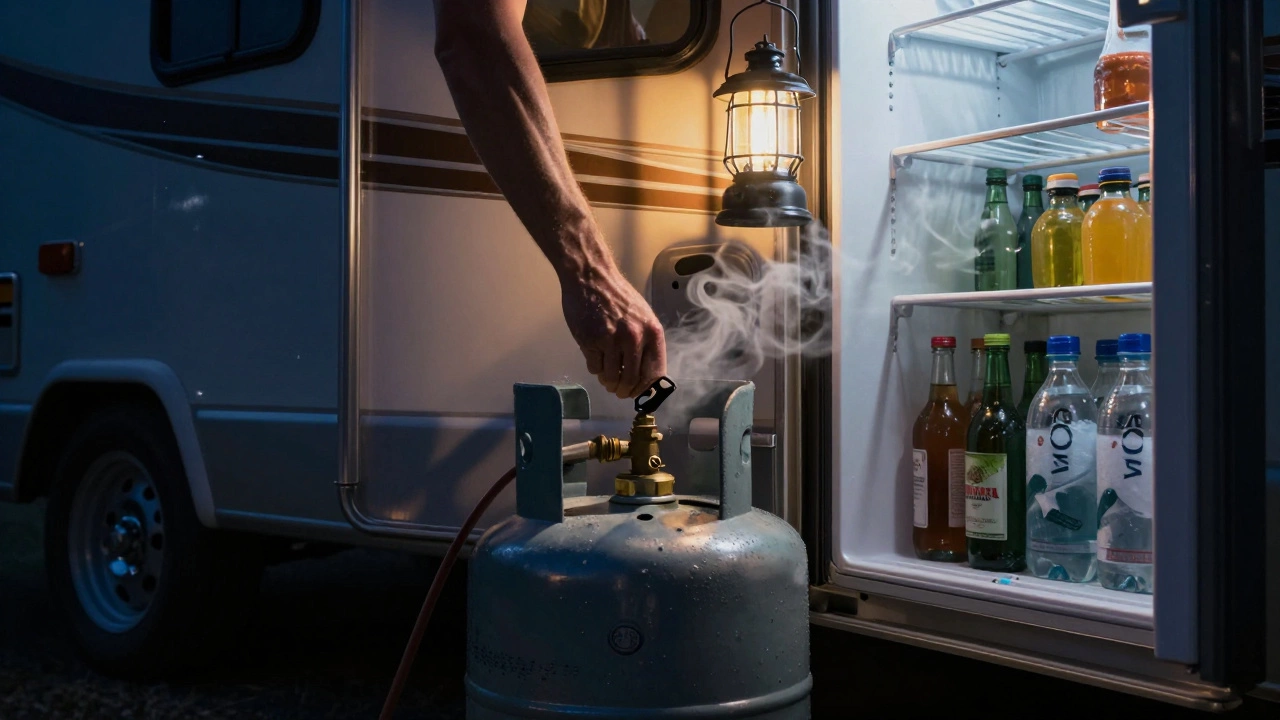
Turn off the propane supply and refrigerator before entering a fuel station. Gasoline and diesel vapors can ignite. The same rule applies when fueling the tow vehicle or the camper.
Do not restart the refrigerator until you have left the fueling area and the vehicle is in a safe, open location.
7 Best RV Propane Refrigerator (Top Picks for Off-Grid Living)
How Does a Camper Refrigerator Use Propane?
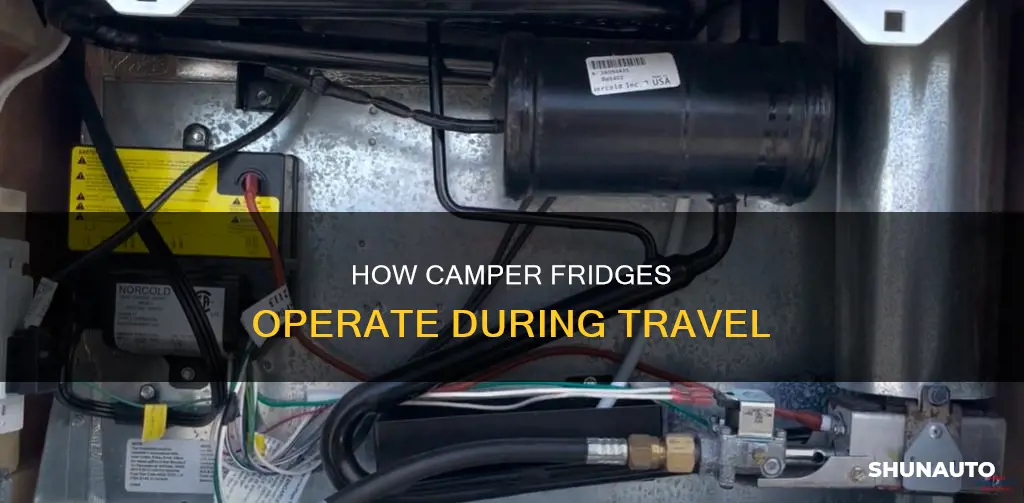
Most older RV refrigerators use an absorption cooling system. Instead of using a compressor, the system uses heat to move refrigerant through a sealed circuit.
That heat can come from:
- A propane burner
- A 120-volt AC heating element
- A 12-volt DC heating element
When the refrigerator is set to LP, the burner creates heat. The refrigerator then uses a chemical process involving ammonia, water, and hydrogen to produce cooling. The system has no large moving compressor, but it still needs a level installation and a clean, stable flame.
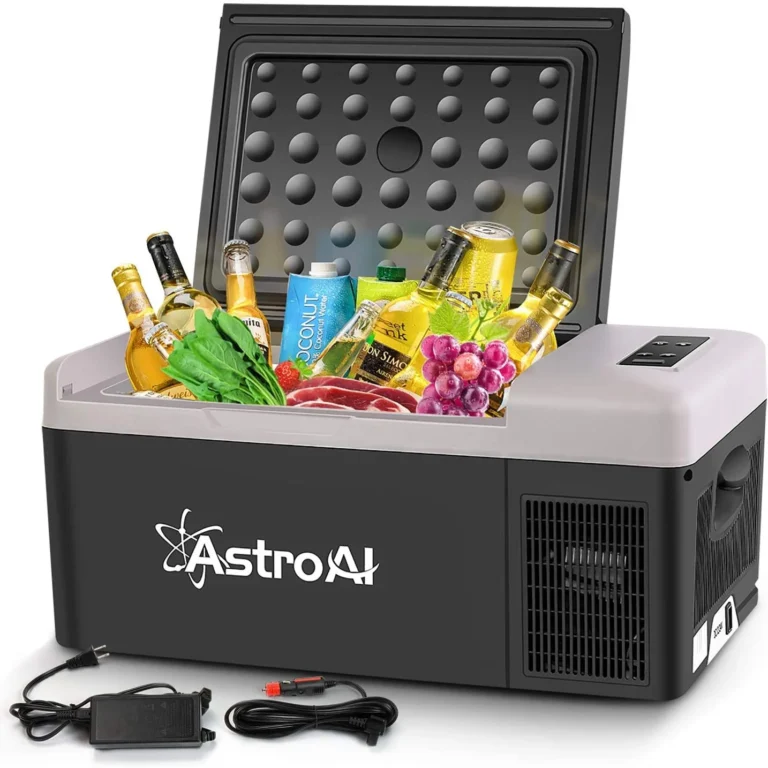
A newer camper may have a compressor refrigerator. A compressor model usually runs from 12-volt DC power or 120-volt AC power. It does not normally use propane.
Common refrigerator types
| Refrigerator type | Propane operation | Main travel consideration |
|---|---|---|
| Two-way absorption refrigerator | Yes, usually LP or 120V AC | Requires a working burner and safe gas system |
| Three-way absorption refrigerator | Yes, plus 12V DC and 120V AC | 12V mode may draw substantial battery power |
| Compressor refrigerator | Usually no | Needs enough battery capacity and charging |
| Residential refrigerator | Usually no | Needs an inverter, shore power, or a suitable battery system |
A three-way refrigerator may offer a 12-volt setting, but that does not always mean it is the best option while driving. Electric heating elements can draw much more power than a small control circuit. The vehicle alternator and wiring must be able to support the load.
When Should You Turn Off the Propane Refrigerator?
Turn off the propane refrigerator before any activity where an open flame or active propane appliance creates extra risk.
Shut it off before:
- Refueling
- Entering a tunnel
- Boarding a ferry
- Crossing a bridge with propane restrictions
- Entering an enclosed parking garage
- Stopping near a fuel spill or gas leak
- Inspecting or repairing the propane system
- Parking in a location that bans open flames
- Transporting the camper where the carrier requires propane to be off
If you smell propane, do not use electrical switches, phones, lighters, or other possible ignition sources near the camper. Move away if you can do so safely, close the main propane valve only if it is safe, and contact emergency services or a qualified RV technician.
Why tunnels and ferries are different
A propane leak in an open outdoor area may disperse. In a tunnel, ferry deck, or enclosed garage, gas can collect in a confined space. Propane is heavier than air, so it may settle in low areas and reach an ignition source.
This is why a route operator may ban propane use even when a state generally allows RV travel with the propane system on.
A simple travel routine
Use this routine at every stop:
- Turn off the refrigerator or switch it to an approved electric mode.
- Close the propane appliance or tank valve if required.
- Refuel.
- Leave the fueling area.
- Confirm that the refrigerator has power.
- Restart it only when local rules and conditions allow.
Do not leave the refrigerator running on propane while the vehicle is unattended at a fuel pump.
Is It Safe to Drive With the Camper Fridge on Propane?
It can be safe when the system is approved, maintained, correctly installed, and allowed on the route. It is not risk-free.
The main hazards include:
- A propane leak
- A damaged gas line after a collision
- A burner flame going out
- Wind or road airflow affecting the burner
- A blocked vent
- An overheated refrigerator compartment
- An electrical or gas fault
- A fire after an accident
Many RV absorption refrigerators have a flame-failure device. This device should shut off the gas if the flame goes out. That feature reduces risk, but it does not replace inspection or proper use.
Conditions that make propane use unsafe
Do not run the refrigerator on propane while driving if:
- The burner will not light or stay lit.
- The refrigerator has a recall or unresolved fault.
- You smell gas.
- The outside vents are blocked.
- The gas line is cracked, loose, or damaged.
- The camper has been in a crash.
- The refrigerator is not level within the manufacturer’s limits.
- The propane tank or cylinder is damaged.
- You are entering a restricted area.
- A qualified technician has advised against operation.
Road vibration can expose a weak fitting or damaged component. If the refrigerator stops working after a hard impact, turn off the propane and have the system inspected.
What safety standards matter?
RV propane systems are commonly built and inspected under standards such as NFPA 1192, Standard on Recreational Vehicles, and applicable federal, state, and local codes. The exact requirements depend on the vehicle, equipment, installation date, and jurisdiction.
A qualified RV service technician can test:
- Propane pressure
- Leak tightness
- Burner condition
- Flame-failure operation
- Ventilation
- Regulator performance
- Refrigerator installation
- Carbon monoxide risk
Do not modify the gas line, add fittings, bypass safety controls, or relocate the refrigerator without proper technical guidance.
Propane vs. 12-Volt Power While Driving
The best power source depends on your refrigerator type, battery system, route, and travel time.
| Power source | Benefits | Limits |
|---|---|---|
| Propane | Low electrical demand; useful for absorption refrigerators | Fire risk; route restrictions; must be shut off when refueling |
| 12V DC | No open flame; often preferred for travel | Can drain the battery if charging is weak |
| 120V AC | Useful at campgrounds or home | Usually unavailable while driving without an inverter |
| Compressor system | Efficient cooling and no propane flame | Needs battery capacity and reliable charging |
A propane absorption refrigerator may use little battery power because the burner supplies the heat. A 12-volt absorption refrigerator can draw a high continuous current. That may overload a small battery or fail to keep the refrigerator cold during a long drive.
A compressor refrigerator often uses electricity more efficiently than a 12-volt absorption refrigerator, but its battery needs still depend on outside temperature, cabinet size, insulation, thermostat setting, and how often the door opens.
A practical energy check
Use this calculation for an approximate battery estimate:
Battery use in amp-hours = current draw in amps × operating hours
For example, a refrigerator that draws 10 amps for 6 hours could use about:
10 amps × 6 hours = 60 amp-hours
This is only a planning estimate. Charging losses, cycling, battery condition, and other loads will change the result. A vehicle alternator may replace some of the energy, but the actual charging rate depends on the tow vehicle, wiring, battery isolator, converter, and battery chemistry.
Check the refrigerator label and manual for its actual 12-volt current draw. Do not rely on a generic estimate.
Which option should you choose?
Use propane while driving only when:
- The refrigerator is designed for LP operation.
- The system passes inspection.
- The route allows it.
- You will shut it off at fuel stops and restricted areas.
- You understand how to monitor the system.
Use 12-volt power when:
- The refrigerator supports it.
- The battery and charging system can handle the load.
- You want to avoid an open flame.
- The route includes tunnels, ferries, or other restrictions.
For a short drive, pre-cooling the refrigerator and keeping the doors closed may be enough. For a long trip, use the power source that matches the refrigerator design and the camper’s energy system.
How to Run an RV Refrigerator on Propane While Driving
Follow the manufacturer’s instructions first. The controls differ by model, but the general process is similar.
Before leaving
- Pre-cool the refrigerator.
Cool the refrigerator on shore power before the trip when possible. Load food that is already cold. - Check the propane system.
Look for damaged hoses, loose connections, rust, or signs of wear. Do not use the system if you smell propane. - Check the refrigerator vents.
Remove leaves, insects, nests, and other blockages from the outside intake and exhaust vents. - Confirm the refrigerator is within its leveling limits.
Absorption refrigerators can be damaged when operated out of level. Use the limits in the manual, not a general rule from another model. - Secure the refrigerator contents.
Prevent bottles and containers from shifting and blocking internal airflow. - Check the route.
Look for tunnel, bridge, ferry, and fuel-station restrictions. - Test the burner before departure.
If the flame is yellow, unstable, unusually noisy, or repeatedly goes out, turn the system off and arrange service.
While driving
- Keep the refrigerator door closed.
- Watch for warning lights or fault codes.
- Do not ignore a gas alarm.
- Stop in a safe outdoor area if you smell propane.
- Turn the system off before refueling.
- Follow signs and instructions from ferry, tunnel, and bridge operators.
- Do not open the refrigerator exterior service panel on the roadside unless the vehicle is safely parked and the system is off.
When you arrive
If you are camping without shore power, confirm that the refrigerator is cooling and that the burner is operating normally. If the camper is parked for a long period, keep the refrigerator level within the manufacturer’s stated range.
If the refrigerator is not cooling, do not keep restarting it on propane. Turn it off and check the likely causes in a safe order.
What to Do if the RV Refrigerator Stops Cooling
A refrigerator that stops cooling may have a power problem, blocked airflow, a leveling issue, a failed burner, or a fault in the cooling unit.
Use this sequence:
1. Check the selected power mode
Confirm that the refrigerator is set to LP, 12V, or AC as intended. Some automatic models may switch modes when the electrical supply changes.
2. Check for a propane supply problem
Make sure the tank valve is open and that other propane appliances work. If no propane appliance works, the tank may be empty or the regulator may have a fault.
Do not keep trying to light the refrigerator if you smell gas.
3. Check the flame and fault light
A failed burner, blocked jet, weak igniter, or safety-control problem may prevent operation. A technician should clean or repair gas components. Do not enlarge a burner jet or bypass the flame-safety device.
4. Check ventilation
The outside refrigerator vents must allow air to enter and hot air to leave. Blocked vents can reduce cooling and create an overheating risk.
5. Check leveling
Move the camper to a level position within the manufacturer’s limits. A brief angle may not cause immediate damage, but prolonged operation outside the permitted range can harm an absorption cooling unit.
6. Check the temperature
Use a refrigerator thermometer rather than judging by touch. The U.S. Food and Drug Administration recommends keeping a refrigerator at 40°F or below and a freezer at 0°F for food safety.
If food has become warm, follow food-safety guidance. When in doubt, discard perishable food rather than relying on smell or appearance.
When to call an RV technician
Get professional help when:
- You smell propane.
- The refrigerator has a soot mark or yellow flame.
- The burner will not stay lit.
- The cooling unit leaks.
- The system overheats.
- A gas alarm activates.
- The camper was in a collision.
- The refrigerator has a known recall.
- You need gas-line or regulator work.
Common Mistakes to Avoid
The most common mistake is treating a working refrigerator as proof that the propane system is safe. A flame can still be hazardous if a line, fitting, vent, or safety control has a problem.
Avoid these errors:
- Leaving the refrigerator on during refueling
- Ignoring local tunnel or ferry rules
- Assuming every state has the same propane law
- Running an absorption refrigerator far out of level
- Blocking the outside vents
- Carrying a damaged propane cylinder
- Using a household extension cord or improvised wiring
- Bypassing a flame-failure device
- Restarting the appliance after smelling gas
- Letting the battery run flat when using 12V mode
- Leaving perishable food in a warm refrigerator
- Failing to service an old refrigerator
Do not use a portable propane appliance inside the camper as a substitute for the built-in refrigerator. Portable appliances can produce carbon monoxide, consume indoor oxygen, and create fire hazards.
The Safest Decision for Your Trip
For most U.S. RV trips, the practical answer is:
- Yes, you may be able to run an approved camper refrigerator on propane while driving.
- No, you should not assume it is allowed on every route.
- Always turn it off before refueling and whenever signs or operators require it.
- Use 12V power when your system can support it and you prefer to avoid an open flame.
- Stop using propane immediately if you smell gas, see an abnormal flame, or suspect damage.
Before departure, read the refrigerator manual, inspect the propane system, confirm the route rules, and plan how to keep food cold during stops.
FAQs
Can I leave my RV refrigerator on propane overnight while parked?
Usually, an approved built-in RV refrigerator can operate on propane while the camper is parked, but it must be level within the manufacturer’s limits and properly ventilated. Follow campground rules, keep the exterior vents clear, and use a working carbon monoxide and propane alarm.
Should I turn off the propane tank when towing an RV?
Not always. Many RVs are designed to travel with propane available, but route restrictions and safety conditions may require the tank to be off. Turn it off before fueling, entering restricted areas, or investigating a suspected leak.
Will an RV refrigerator stay cold if I turn off the propane while driving?
A well-chilled refrigerator can remain cold for a limited time if the door stays closed. The exact time depends on outside temperature, food load, insulation, and refrigerator condition. A 12V setting or compressor refrigerator may maintain cooling without an open flame.
Can I run a three-way camper fridge on 12V while driving?
Yes, if the refrigerator supports 12V operation and the camper’s battery and charging system can supply the required current. Check the model’s electrical rating. Some three-way absorption refrigerators use enough power to drain a battery quickly when charging is weak.
What should I do if I smell propane while driving?
Stop in a safe outdoor location as soon as possible. Turn off the propane supply if you can do so without creating danger. Do not use switches, flames, or devices that could cause a spark near the camper. Move away and contact emergency services or a qualified RV technician.
Where can I verify propane restrictions for my route?
Check the websites or customer-service lines for your state transportation agency, tunnel and bridge operator, ferry company, and campground. Look for signs at each facility. Rules can change by route and vehicle type, so verify the specific trip rather than relying on a general RV rule.
Sources to Check
- National Fire Protection Association — NFPA 1192, Standard on Recreational Vehicles
- U.S. Department of Transportation — Pipeline and Hazardous Materials Safety Administration
- U.S. Food and Drug Administration — Refrigerator and Food Safety
- Your refrigerator manufacturer’s owner’s manual
- Your camper manufacturer’s propane-system instructions
- The official operator for each tunnel, bridge, or ferry on your route